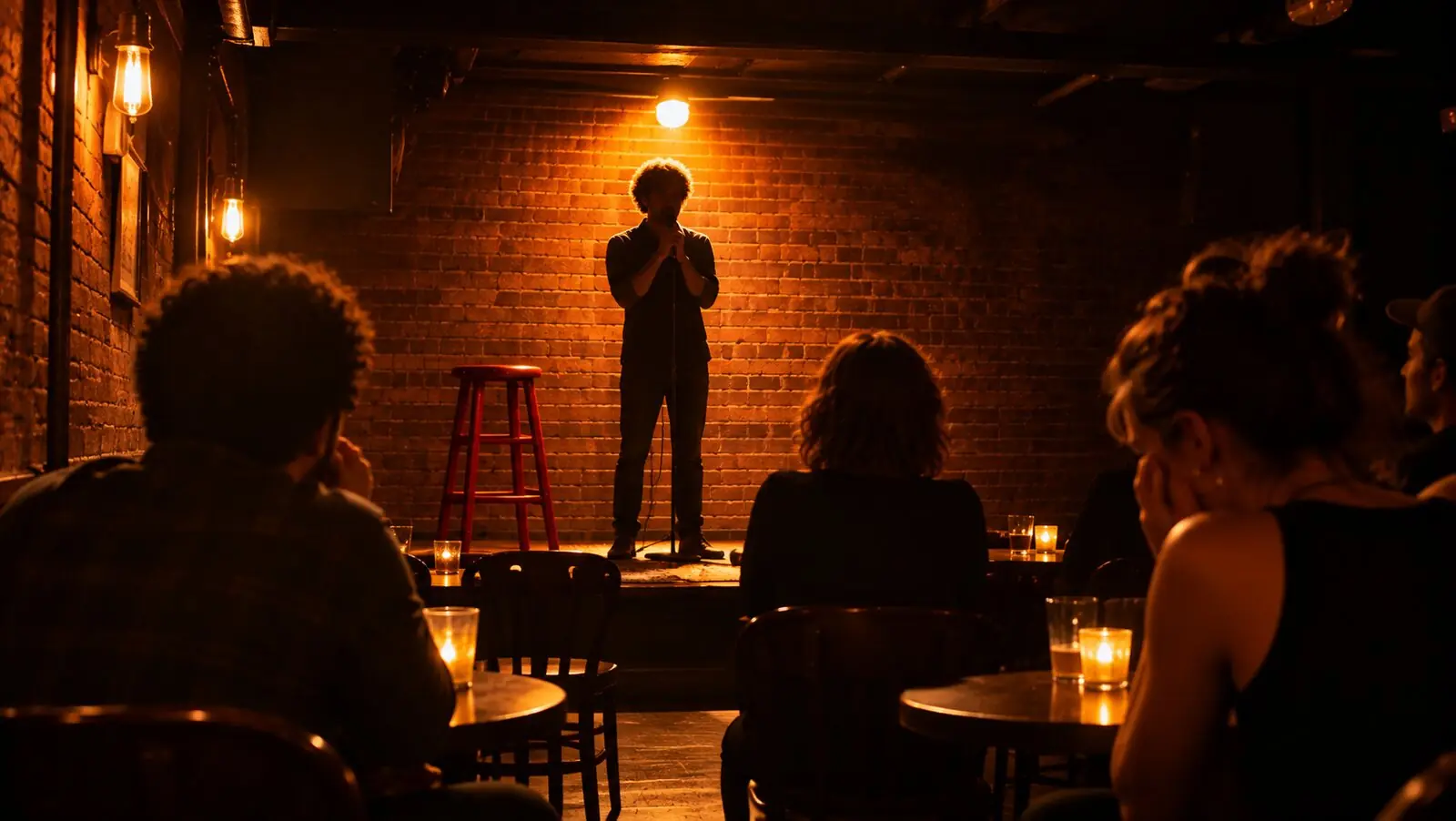
Open mics near you, night by night
Where comics try tonight's new jokes and new comics get their first five. The mics on each room's own listing, the next two weeks, and every room's weekly mic night with how to get on. A night out for a few dollars, often none.
329 open mics on the rooms' own listings in the next 60 days, at 69 rooms in 64 towns, and the weekly mic nights of 253 rooms.
Open mics, night by night
The next two weeks, from each room's own listing. Your town first, where you have set one.
Friday 13 November 2026 5 mics
- Weekly 9:30 PM — Open Mic Night · Clint's Comedy Club, Overland Park, KS · the listing ↗Plan this night →
- Weekly 10:00 PM — Late Night Open Mic · Mic Drop Comedy, San Diego, CA · the listing ↗Plan this night →
- Weekly 10:00 PM — New Jack Open Mic · Sunshine City Comedy Club, St. Pete Beach, FL · the listing ↗Plan this night →
- Weekly 10:00 PM — Friday Night Open Mic · The Comedy Corner Underground, Minneapolis, MN · the listing ↗Plan this night →
- Weekly 11:59 PM — New Talent Open Mic Show · The Tiny Cupboard, Brooklyn, NY · the listing ↗Plan this night →
Saturday 14 November 2026 2 mics
- Monthly 4:00 PM — The Industry Room Audition Show. America’s Best Comedy Open Mic. · Broadway Comedy Club, New York, NY · the listing ↗Plan this night →
- Weekly 11:59 PM — New Talent Open Mic Show · The Tiny Cupboard, Brooklyn, NY · the listing ↗Plan this night →
Sunday 15 November 2026 6 mics
- Weekly 5:30 PM — Comedy Mob Open Mic · New York Comedy Club – East Village, New York, NY · the listing ↗Plan this night →
- 6:00 PM — Back to the Feature Comedy Open Mic hosted by Jeremy Crawford · Boomerang Comedy Theater, Baton Rouge, LA · the listing ↗Plan this night →
- Weekly 6:00 PM — Sunday Open Mic · Eastville Comedy Club, Brooklyn, NY · the listing ↗Plan this night →
- Monthly 6:00 PM — Open Mic From Scratch · Mic Drop Comedy, San Diego, CA · the listing ↗Plan this night →
- Weekly 8:00 PM — Sunday Open Mic · Sunshine City Comedy Club, St. Pete Beach, FL · the listing ↗Plan this night →
- Weekly 11:00 PM — New Talent Open Mic Show · The Tiny Cupboard, Brooklyn, NY · the listing ↗Plan this night →
Monday 16 November 2026 9 mics
- One night only 7:30 PM — Church of Satire Open Mic Night · Church of Satire Comedy Club, Hanover, PA · the listing ↗Plan this night →
- Weekly 7:30 PM — Denver Comedy Open Mic · Denver Comedy Underground, Denver, CO · the listing ↗Plan this night →
- Weekly 8:00 PM — The Big Laugh Open Mic · Big Laugh Comedy Club Fort Worth - Funky Room [Downstairs], Fort Worth, TX · the listing ↗Plan this night →
- Weekly 8:00 PM — Open Mic Night – Monday November 16 at 8:00PM · Laughing Skull Lounge, Atlanta, GA · the listing ↗Plan this night →
- Weekly 8:00 PM — Open Mic Night · The Comedy Vault, Batavia, IL · the listing ↗Plan this night →
- Weekly 8:00 PM — FREE Open Mic Comedy Night at The World Famous Mad House Comedy Club – Watch careers start and dreams die… 5 minutes at a time! · The World Famous Mad House Comedy Club, San Diego, CA · the listing ↗Plan this night →
- 9:00 PM — Riot Comedy Club presents Monday Night Standup Comedy Open Mic · The Riot Houston, Houston, TX · the listing ↗Plan this night →
- 10:00 PM — Riot Comedy Club presents Monday Night Standup Comedy Open Mic · The Riot Riverwalk, San Antonio, TX · the listing ↗Plan this night →
- Weekly 11:00 PM — New Talent Open Mic Show · The Tiny Cupboard, Brooklyn, NY · the listing ↗Plan this night →
Tuesday 17 November 2026 13 mics
- Weekly Comedy Open Mic at SoulJoel's · SoulJoel's, Pottstown, PA · the listing ↗Plan this night →
- Monthly 7:00 PM — CLEAN COMEDY Open Mic Night · Spokane Comedy Club, Spokane, WA · the listing ↗Plan this night →
- Monthly 7:00 PM — CLEAN COMEDY Open Mic Night · Tacoma Comedy Club – Downtown, Tacoma, WA · the listing ↗Plan this night →
- 7:00 PM — Open Mic - Try It on Tuesday · The Funny Pages Restaurant and Comedy Club, Gulfport, MS · the listing ↗Plan this night →
- Weekly 7:30 PM — Late Night Open Mic · Mic Drop Comedy, San Diego, CA · the listing ↗Plan this night →
- Weekly 8:00 PM — Gaslamp Open Mic & $5 Happy Hour LIVE! [TUE] · American Comedy Co., San Diego, CA · the listing ↗Plan this night →
- Weekly 8:00 PM — Comedy Key West Open Mic · Comedy Key West, Key West, FL · the listing ↗Plan this night →
- Weekly 8:00 PM — Open Mic Night – Tuesday November 17 at 8:00PM · Laughing Skull Lounge, Atlanta, GA · the listing ↗Plan this night →
- Weekly 8:00 PM — Open Mic Tuesday at Sunshine City Comedy Club! · Sunshine City Comedy Club, St. Pete Beach, FL · the listing ↗Plan this night →
- 8:30 PM — The Punch-up Open Mic w/ Beth Stelling & special guest host XX · Upright Citizens Brigade Theatre, Los Angeles, CA · the listing ↗Plan this night →
- 10:00 PM — Riot Comedy Club presents Tuesday Night Standup Comedy Open Mic · The Riot Riverwalk, San Antonio, TX · the listing ↗Plan this night →
- Weekly 10:00 PM — FREE Open Mic Comedy Night at The World Famous Mad House Comedy Club – Watch careers start and dreams die… 5 minutes at a time! · The World Famous Mad House Comedy Club, San Diego, CA · the listing ↗Plan this night →
- Weekly 11:00 PM — New Talent Open Mic Show · The Tiny Cupboard, Brooklyn, NY · the listing ↗Plan this night →
Wednesday 18 November 2026 22 mics
- Weekly Open Mic Night · HaHa Comedy Club, North Hollywood, CA · the listing ↗Plan this night →
- Weekly 6:00 PM — FREE Comedy Open Mic · Deaf Puppy Comedy Club, Manteca, CA · the listing ↗Plan this night →
- Weekly 6:30 PM — Open Mic hosted by Marcus Mangham - in the Callback Bar · Punch Line Comedy Club - Sacramento, Sacramento, CA · the listing ↗Plan this night →
- Every two weeks 7:00 PM — Open Mic Night · Bricktown Comedy Club, Oklahoma City, OK · the listing ↗Plan this night →
- 7:00 PM — NEVER ENDING Open Mic Night · Bricktown Comedy Club Tulsa, Tulsa, OK · the listing ↗Plan this night →
- Monthly 7:00 PM — Work It Out Wednesday Open Mic · Huntsville Levity Live, Huntsville, AL · the listing ↗Plan this night →
- Weekly 7:00 PM — Open Mic Night · Louisville Comedy Club, Louisville, KY · the listing ↗Plan this night →
- Weekly 7:00 PM — Open Mic Night · Skyline Comedy Club, Appleton, WI · the listing ↗Plan this night →
- Weekly 7:00 PM — Open Mic Night · Spokane Comedy Club, Spokane, WA · the listing ↗Plan this night →
- Weekly 7:00 PM — Open Mic Night · Springfield Comedy Club, Springfield, MO · the listing ↗Plan this night →
- Every two weeks 7:00 PM — Open Mic Night · Tacoma Comedy Club – Downtown, Tacoma, WA · the listing ↗Plan this night →
- Weekly 7:00 PM — Open Mic · Wiseguys Comedy Club – The Gateway, Salt Lake City, UT · the listing ↗Plan this night →
- Weekly 7:00 PM — Open Mic · Wiseguys Comedy Club – Town Square, Las Vegas, NV · the listing ↗Plan this night →
- One night only 7:30 PM — Open Mic · Mark Ridley's Comedy Castle, Royal Oak, MI · the listing ↗Plan this night →
- Monthly 7:30 PM — Open Mic From Scratch · Mic Drop Comedy, San Diego, CA · the listing ↗Plan this night →
- Weekly 8:00 PM — Free Open Mic Comedy Night · Give a Hoot Comedy Club, Gaithersburg, MD · the listing ↗Plan this night →
- Monthly 8:00 PM — Open Mic at Goodnights · Goodnights Comedy Club, Raleigh, NC · the listing ↗Plan this night →
- Weekly 8:00 PM — Open Mic Night! · Juke Box Comedy Club, Peoria, IL · the listing ↗Plan this night →
- Weekly 8:00 PM — Open Mic Night – Wednesday November 18 at 8:00PM · Laughing Skull Lounge, Atlanta, GA · the listing ↗Plan this night →
- Every two weeks 8:30 PM — Standup Open Mic · Vermont Comedy Club, Burlington, VT · the listing ↗Plan this night →
- Weekly 9:30 PM — Wizop Wednesday's Open Mic Night · Big Laugh Comedy Club Fort Worth - Funky Room [Downstairs], Fort Worth, TX · the listing ↗Plan this night →
- Weekly 11:00 PM — New Talent Open Mic Show · The Tiny Cupboard, Brooklyn, NY · the listing ↗Plan this night →
Thursday 19 November 2026 13 mics
- Weekly Open Mic Night · HaHa Comedy Club, North Hollywood, CA · the listing ↗Plan this night →
- Weekly 7:00 PM — Comedy Open Mic tonight!! · Cozzy's Comedy Club, Newport News, VA · the listing ↗Plan this night →
- 7:00 PM — Comedy Open Mic Night- No Cover · Cristy B Comedy Club, Daytona Beach, FL · the listing ↗Plan this night →
- Every two weeks 7:00 PM — Open Mic Night · Summit City Comedy Club, Fort Wayne, IN · the listing ↗Plan this night →
- 7:00 PM — Thursday November 19: Detroit's Best Comedy+ Open Mic · The Comedy Bar (Detroit), Detroit, MI · the listing ↗Plan this night →
- Every two weeks 7:00 PM — FREE Open Mic Night · The Well Comedy Club, Bakersfield, CA · the listing ↗Plan this night →
- Weekly 7:00 PM — Open Mic Night · West River Comedy Club, Rapid City, SD · the listing ↗Plan this night →
- One night only 8:00 PM — Standup Open Mic · BABS Comedy Club, Forest Park, IL · the listing ↗Plan this night →
- 8:00 PM — Backdoor Comedy Open Mic · Backdoor Comedy Club, Richardson, TX · the listing ↗Plan this night →
- Every two weeks 8:00 PM — Open Mic Comedy · Dead Crow Comedy Room, Wilmington, NC · the listing ↗Plan this night →
- Weekly 8:00 PM — Open Mic Night! · Juke Box Comedy Club, Peoria, IL · the listing ↗Plan this night →
- Every two weeks 9:30 PM — Open Mic · The Comedy Club of Kansas City, Kansas City, MO · the listing ↗Plan this night →
- Every two weeks 9:30 PM — Open Mic · The Comedy Club of Lawrence, Lawrence, KS · the listing ↗Plan this night →
Friday 20 November 2026 4 mics
- Weekly 9:30 PM — Open Mic Night · Clint's Comedy Club, Overland Park, KS · the listing ↗Plan this night →
- Weekly 10:00 PM — New Jack Open Mic · Sunshine City Comedy Club, St. Pete Beach, FL · the listing ↗Plan this night →
- Weekly 10:00 PM — Friday Night Open Mic · The Comedy Corner Underground, Minneapolis, MN · the listing ↗Plan this night →
- Weekly 11:30 PM — Friday Night Late Night Open Mic · Eastville Comedy Club, Brooklyn, NY · the listing ↗Plan this night →
Saturday 21 November 2026 2 mics
- Monthly 4:00 PM — The Industry Room. New York’s Best Open Mic Show. · Broadway Comedy Club, New York, NY · the listing ↗Plan this night →
- Weekly 11:30 PM — Saturday Night Late Night Open Mic · Eastville Comedy Club, Brooklyn, NY · the listing ↗Plan this night →
Sunday 22 November 2026 6 mics
- Weekly 4:00 PM — Sunday Open Mic · Eastville Comedy Club, Brooklyn, NY · the listing ↗Plan this night →
- Weekly 5:00 PM — Sunday Open Mic · Eastville Comedy Club, Brooklyn, NY · the listing ↗Plan this night →
- Weekly 5:30 PM — Comedy Mob Open Mic · New York Comedy Club – East Village, New York, NY · the listing ↗Plan this night →
- Weekly 6:00 PM — Sunday Open Mic · Eastville Comedy Club, Brooklyn, NY · the listing ↗Plan this night →
- Weekly 6:00 PM — Late Night Open Mic · Mic Drop Comedy, San Diego, CA · the listing ↗Plan this night →
- Weekly 8:00 PM — Sunday Open Mic · Sunshine City Comedy Club, St. Pete Beach, FL · the listing ↗Plan this night →
Monday 23 November 2026 6 mics
- Every two weeks 7:00 PM — Punch Line Philly Open Mic Night · Punch Line Philly, Philadelphia, PA · the listing ↗Plan this night →
- Weekly 7:30 PM — Denver Comedy Open Mic · Denver Comedy Underground, Denver, CO · the listing ↗Plan this night →
- Weekly 8:00 PM — The Big Laugh Open Mic · Big Laugh Comedy Club Fort Worth - Funky Room [Downstairs], Fort Worth, TX · the listing ↗Plan this night →
- Weekly 8:00 PM — Open Mic Night – Monday November 23 at 8:00PM · Laughing Skull Lounge, Atlanta, GA · the listing ↗Plan this night →
- Weekly 8:00 PM — Open Mic Night · The Comedy Vault, Batavia, IL · the listing ↗Plan this night →
- Weekly 8:00 PM — FREE Open Mic Comedy Night at The World Famous Mad House Comedy Club – Watch careers start and dreams die… 5 minutes at a time! · The World Famous Mad House Comedy Club, San Diego, CA · the listing ↗Plan this night →
Tuesday 24 November 2026 11 mics
- Weekly Comedy Open Mic at SoulJoel's · SoulJoel's, Pottstown, PA · the listing ↗Plan this night →
- One night only 7:00 PM — THE NEVER ENDING Open Mic · Bricktown Comedy Club, Oklahoma City, OK · the listing ↗Plan this night →
- Every two weeks 7:00 PM — New Talent Tuesday · Louisville Comedy Club, Louisville, KY · the listing ↗Plan this night →
- One night only 7:00 PM — NEVER ENDING Open Mic Night · Spokane Comedy Club, Spokane, WA · the listing ↗Plan this night →
- 7:00 PM — THE NEVER ENDING Open Mic · Tacoma Comedy Club – Downtown, Tacoma, WA · the listing ↗Plan this night →
- Weekly 7:30 PM — Open Mic Night · Cap City Comedy Club, Austin, TX · the listing ↗Plan this night →
- Weekly 8:00 PM — Gaslamp Open Mic & $5 Happy Hour LIVE! [TUE] · American Comedy Co., San Diego, CA · the listing ↗Plan this night →
- Weekly 8:00 PM — Comedy Key West Open Mic · Comedy Key West, Key West, FL · the listing ↗Plan this night →
- Weekly 8:00 PM — Open Mic Night – Tuesday November 24 at 8:00PM · Laughing Skull Lounge, Atlanta, GA · the listing ↗Plan this night →
- Weekly 8:00 PM — Open Mic Tuesday at Sunshine City Comedy Club! · Sunshine City Comedy Club, St. Pete Beach, FL · the listing ↗Plan this night →
- Weekly 10:00 PM — FREE Open Mic Comedy Night at The World Famous Mad House Comedy Club – Watch careers start and dreams die… 5 minutes at a time! · The World Famous Mad House Comedy Club, San Diego, CA · the listing ↗Plan this night →
Wednesday 25 November 2026 12 mics
- Weekly Open Mic Night · HaHa Comedy Club, North Hollywood, CA · the listing ↗Plan this night →
- Comedy Open Mic · Off Cabot Comedy and Events, Beverly, MA · the listing ↗Plan this night →
- Weekly 6:00 PM — Wednesday Night Open Mic · Eastville Comedy Club, Brooklyn, NY · the listing ↗Plan this night →
- Weekly 6:30 PM — Open Mic hosted by Marcus Mangham - in the Callback Bar · Punch Line Comedy Club - Sacramento, Sacramento, CA · the listing ↗Plan this night →
- Weekly 7:00 PM — Open Mic Night · Stardome Comedy Club, Birmingham, AL · the listing ↗Plan this night →
- Weekly 7:00 PM — Open Mic · Wiseguys Comedy Club – The Gateway, Salt Lake City, UT · the listing ↗Plan this night →
- Weekly 7:00 PM — Open Mic · Wiseguys Comedy Club – Town Square, Las Vegas, NV · the listing ↗Plan this night →
- Weekly 7:30 PM — Late Night Open Mic · Mic Drop Comedy, San Diego, CA · the listing ↗Plan this night →
- Weekly 8:00 PM — Free Open Mic Comedy Night · Give a Hoot Comedy Club, Gaithersburg, MD · the listing ↗Plan this night →
- Weekly 8:00 PM — Open Mic Night! · Juke Box Comedy Club, Peoria, IL · the listing ↗Plan this night →
- Weekly 8:00 PM — Open Mic Night – Wednesday November 25 at 8:00PM · Laughing Skull Lounge, Atlanta, GA · the listing ↗Plan this night →
- Weekly 9:30 PM — Wizop Wednesday's Open Mic Night · Big Laugh Comedy Club Fort Worth - Funky Room [Downstairs], Fort Worth, TX · the listing ↗Plan this night →
Thursday 26 November 2026 3 mics
- Weekly 6:00 PM — Thursday Night Open Mic · Eastville Comedy Club, Brooklyn, NY · the listing ↗Plan this night →
- Weekly 7:00 PM — Open Mic Night · West River Comedy Club, Rapid City, SD · the listing ↗Plan this night →
- Weekly 8:00 PM — Open Mic Night! · Juke Box Comedy Club, Peoria, IL · the listing ↗Plan this night →
Every week, room by room
The rooms' regular mic nights and how to get on, state by state.
Alabama 3
- Mon7:30 PM Cahaba Brewing Co. (CaHAHAba Open Mic Comedy) Birmingham, AL
-
Sun
Stardome Comedy Club Birmingham, ALsee the club's calendar
How to get on
Sign up with the form on the club's Open Mic page, which closes the Sunday before; prepare at least 3 minutes. Any spots left go to in-person sign-ups in the showroom by 5:30 PM on the night; the list is posted by 6:00 PM
- Wed7:00 PM Huntsville Levity Live Huntsville, AL
Arizona 5
-
Thu · Sat7:00 PM
Mic Drop Comedy Chandler Chandler, AZOnce Upon A Mic (not every Thursday; the odd late Saturday at 9:30 PM)
How to get on
Free for comics; sign-ups begin when doors open (6:00 PM for the Thursday mic); 4-minute sets, names pulled from a bucket
-
Wed
Stir Crazy Comedy Club Glendale, AZ
How to get on
Sign up online from noon to 1:00 PM on the Sunday before; ten performers are then drawn at random for three-minute spots (seven minutes for a comic who brings three guests); others may buy a ticket and join the stand-by list at the club
-
Wed
Stand Up Live Phoenix, AZ
How to get on
Email NewFacesAZ@gmail.com to sign up; five minutes each
-
Varies
Tempe Improv Tempe, AZthe dates vary; see the club's calendar
How to get on
Email NewFacesAZ@gmail.com to sign up; 5-minute sets.
-
Thu8:00 PM
Laffs Comedy Caffe Tucson, AZ
How to get on
Call ahead on (520) 32-FUNNY, then line up to sign up: be at Laffs by 7:00 PM; must be 21; free
Arkansas 1
-
Wed8:00 PM
Loony Bin Comedy Club Little Rock, AROpen Mic Night; $7 audience tickets
How to get on
Sign-ups start at 2:00 PM on the day; a comic gets 3 minutes, plus a minute for each guest they bring, up to 10; guests arrive by 7:55 PM and comics check in by 7:45 PM
California 28
-
Sat10:00 PM
Alameda Comedy – Fireside Lounge Alameda, CA
How to get on
Come along and sign up to take the stage
-
Wed7:30 PM
Flappers Comedy Club Burbank, CAHappy Hour Auditions in the Flappers bar
How to get on
Pre-register on the club's Auditions page by claiming a free ticket; the first 25 comedians who sign up are seen; prepare your best two-minute set; feedback afterwards
-
Varies
The Nitecap Burbank, CADaily, seven days a week
How to get on
Improvisation, long-set and character mics among them; sign-up through the link on its FAQ page
-
Sun8:30 PM
Grand Comedy Club Escondido, CA
How to get on
Drop your name in the hat at 6:00 PM for the draw; everyone who shows up goes up; three minutes on stage, or five if you buy an item; comedy only; free
-
Wed · Sun8:00 PM
The Glendale Room Glendale, CAOpen Mic Comedy Wednesdays; Sundays, 4:00 PM — Trainwreck Open Mic Comedy Sundays
How to get on
Twenty comics chosen by bucket draw; five-minute sets; running order drawn from the bucket
-
Tue7:00 PM
The Comedy Store La Jolla La Jolla, CAthe Set of the Night contest; no cover
How to get on
Call 858-454-9176 between noon and 5:00 PM on the Tuesday the week before and give your name; names are drawn at random at 5:00 PM on Instagram and Facebook Live (or call back after 5:30 PM); 3-minute sets; check in with the host at 6:45 PM
-
Tue6:30 PM
Laugh Factory Long Beach Long Beach, CA
How to get on
Call the club at (562) 495-2844 for details
-
Tue5:30 PM
Laugh Factory Hollywood Los Angeles, CA
How to get on
Sign-up 5:00–5:30 PM via a QR code at the door; 2-minute sets; lineup picked at random by lottery; stage time not guaranteed
-
Thu · Sun8:00 PM
The Clubhouse Los Angeles, CANice Mic; open-mic spots at the Stand Up Showcase on the second and fourth Sundays, 9:00 PM
How to get on
Nice Mic: sign up at the door for a five-minute slot; sign-ups open 15 minutes before the show
-
Sun · Mon6:00 PM
The Comedy Store Los Angeles, CAPotluck
How to get on
Sign up in person on the patio between 4:00 and 5:00 PM; the list of performers goes up in the Original Room; check in with the host; doors 5:30 PM
-
Mon · Tue · Thu · Fri9:00 PM
The Lyric Hyperion Los Angeles, CAHoopla Open Mic Comedy Night; daytime comedy mics on Mondays, Tuesdays, Thursdays and Fridays
How to get on
Sign up by bucket draw for a four-minute set; free to watch
- Wed7:00 PM Deaf Puppy Comedy Club Manteca, CAFree Wednesday Open Mic
- Wed · Thu6:00 PM HaHa Comedy Club North Hollywood, CAsee the club's calendar
-
Sun7:00 PM
The Comedy Chateau North Hollywood, CAclub auditions and open mic
How to get on
First come, first served; bring your best three minutes; everyone gets seen
- Tue8:00 PM Ontario Improv Ontario, CAOpen Mic at the Ontario Improv
-
Thu6:00 PM
The Ice House Comedy Pasadena, CABreaking the Ice Open Mic in the California Room; free to attend, 21 and over
How to get on
Doors open at 5:00 PM; each food or drink item bought at the bar earns one entry in the bucket pull; names are drawn, each comic goes up once, for three minutes
-
Wed7:30 PM
Tommy T's Comedy Club Pleasanton, CA
How to get on
Sign yourself in at the club from 7:00 PM, before 7:30; the first 30 comics only; bring four minutes of written material (light at three minutes)
-
Tue7:00 PM
Laughs Unlimited Sacramento, CAthe Pro-Am Showcase; the club's calendar says 7:00 PM and its FAQ 8:00 PM
How to get on
Email bookinglaughs@gmail.com (subject 'PRO-AM Submission') with your name and how many guests you'll bring; spot confirmed by email; 3-minute set.
-
Wed6:30 PM
Punch Line Sacramento Sacramento, CA
How to get on
Sign-ups open at noon the day before, by email to the host — the address is on the club's Callback Bar page. The first five get guaranteed spots and the rest enter a raffle on arrival; bringing ticketed guests earns extra raffle entries
-
Tue8:00 PM
Sacramento Comedy Spot Sacramento, CA
How to get on
Sign up in person at 7:30 PM with the host outside or in the lobby — no early, late, email, text or voicemail sign-ups; about 20 comics, up to five minutes each; 18 and over; bring someone who buys a ticket and you are on the list
-
Tue8:00 PM
American Comedy Co. San Diego, CAGaslamp Open Mic and $5 Happy Hour (doors 7:15 PM); no cover, no drink minimum
How to get on
Sign up between 7:15 and 7:50 PM; names are pulled; bring one friend for an extra minute if your name is pulled, or five friends for a guaranteed spot
-
Sat · Sun3:00 PM
Mic Drop Comedy San Diego, CAOnce Upon A Mic, in the Gold Room; and some Sundays at 12:30 PM, the clean Daytime at Mic Drop mic
How to get on
Email info@micdropcomedy.com to ask how to get on
-
Mon · Tue8:00 PM
The World Famous Mad House Comedy Club San Diego, CA
How to get on
Sign up ahead, only on the Sunday before each Monday-to-Sunday week, through the link on the club's open-mic Instagram page; no walk-ins and no alternate list; everyone who signs up goes on; sets usually three minutes, uncensored; check in with the host on arrival; 21 and over; no drink minimum for comics
- Wed8:00 PM San Jose Improv San Jose, CAOpen Mic at the San Jose Improv
-
Mon · Tue · Sun9:00 PM
Crow Comedy Club Santa Monica, CA
How to get on
Sign up on Slotted (Slice Mic: Fridays at noon; Boys Drool: Thursdays at 4:00 PM); $5 for 5 minutes; audience free
-
Tue · Sat10:00 PM
Westside Comedy Theater Santa Monica, CAThe Tuesday Open Mic (be there by 9:45 PM); also The Witching Hour, a mic for female and nonbinary comics (all welcome), most Saturdays, 6:00 PM to 7:30 PM
How to get on
Tuesday: a $2 ticket; performers write their name on a slip for the bucket onstage, 20 to 25 names are drawn up front and go up in random order, three minutes each. Witching Hour: $5 for five minutes — buy a ticket, then sign up on Slotted; the sheet opens Wednesdays at 11:00 AM
-
Wed · Mon6:00 PM
Barrel Proof Lounge Santa Rosa, CAWednesday Night Comedy Open Mic; also the Be Ready Comedy Open Mic and workshop on some Mondays, 6:00 PM
How to get on
Twenty spots drawn from pre-sign-ups (10:00 AM to noon on the BACN Facebook group) and fifteen walk-in spots from 5:00 PM; four-minute sets
-
Wed8:00 PM
Rooster T. Feathers Comedy Club Sunnyvale, CARooster’s Comedy Showcase: a professional host and headliner, with pre-booked spots for amateurs and club regulars
How to get on
Email roosterbookings@yahoo.com with the subject line “RCS Request” and wait for a confirmed date; do not turn up to perform without one
Colorado 3
-
Tue
Comedy Works Downtown Denver, CONew Talent Night
How to get on
Create an account at nts.comedyworks.com and register each week for the next available show; performers are picked from those with the most accumulated sign-ups (the club says it can take 15–17 sign-ups to get on); questions to newtalentinfo@comedyworks.com
- Mon7:30 PM Denver Comedy Underground Denver, COthe Denver Comedy Open Mic
-
Mon
The Comedy Fort Fort Collins, CO
How to get on
Sign up online a week ahead — sign-ups close at 6:00 PM on the Monday before; chosen comics are emailed a week ahead; check in at the front desk by 6:45 PM; a standby list opens at the door at 6:30 PM; two minutes the first time, three after that, four or more for regulars; free, 21 and over
Connecticut 1
-
Mon7:30 PM
New York Comedy Club Stamford Stamford, CTMonday Night Mic (free entry, one-drink minimum)
How to get on
Sign up to perform through the Open Mics calendar on the club's website
Delaware 1
- Tue7:00 PM Cool J's AfterDARK Bear, DEthe Major Standup Open Mic
Florida 12
-
Sun · Wed6:00 PM
Ft. Lauderdale Improv Dania Beach, FLOpen Mic Night
How to get on
Email NewFacesFL@gmail.com to sign up; five minutes each
- Thu9:00 PM Cristy B Comedy Club Daytona Beach, FLComedy Open Mic Night, no cover (listed for 12 and 19 November 2026)
-
Tue · Wed8:00 PM
Miami Improv Doral, FLsee the club's calendar
How to get on
Email NewFacesFL@gmail.com, the sign-up address for the Florida Improv clubs; 5-minute sets
-
Fri
Snappers Comedy Club Fort Myers, FL
How to get on
Email snappersopenmic@gmail.com to sign up; a comic and a live DJ host; first-timers and veteran comics alike
-
Tue8:00 PM
Comedy Key West Key West, FL
How to get on
Sign up after 7:00 PM; five-minute spots; comedians, musicians, poets and other performers welcome
-
Thu7:15 PM
Orlando Funny Bone Comedy Club & Restaurant Orlando, FLOpen Mic Night, in the bar area rather than the main showroom
How to get on
Sign up in person 30 minutes before showtime; you must be present, and you cannot sign up a friend. Sets are usually 3–5 minutes, and management may add comics not on the list. Free, all ages.
-
Wed · Thu7:00 PM
Talk to the Moon Comedy Club Pensacola, FL
How to get on
Wednesday: sign-up posted on its social media each Monday before noon, 16-comic limit, about 5 minutes; Thursday: sign-up posted Tuesday before noon or in person 6:30 to 7:00 PM
-
Wed · Thu9:00 PM
McCurdy's Comedy Theatre Sarasota, FL
How to get on
Sign up in advance by email through the club's Contact Us page; 5-minute spots; 18 and over
-
Tue · Fri · Sun8:00 PM
Sunshine City Comedy Club St. Pete Beach, FL
How to get on
Sign up in person — the list opens an hour before the start, first come, first served; $5 for performers and audience; no drink minimum
-
Sun
Side Splitters Comedy Club (Tampa) Tampa, FLComic's Night Out
How to get on
Email comicsnightout@gmail.com to sign up; 5 minutes per performer.
-
Thu8:00 PM
Tampa Funny Bone Comedy Club & Restaurant Tampa, FLMic Nite, on the bar stage
How to get on
Sign up at the club from 7:00 PM; the draw order is random. 5-minute sets, 25 performers. Free, no ticket needed, 21 and over to enter or perform. Questions to Micnite813@funnybone.com
-
Wed7:30 PM
Palm Beach Improv Wellington, FLOpen Mic Night
How to get on
Email NewFacesFL@gmail.com to sign up; five minutes each
Georgia 3
-
Wed
Helium Comedy Club - Atlanta Alpharetta, GAsee the club's calendar
How to get on
Sign up at the box office on the night, from 6:30 PM (the club gives both 7:15 PM and 7:30 PM as the cut-off); the line-up is drawn by random lottery; prepare at least three minutes
-
Mon · Tue · Wed8:00 PM
Laughing Skull Lounge Atlanta, GA
How to get on
Pre-booked, usually two to three weeks ahead: email laughingskullopenmic@gmail.com with your name, whether it is your first time doing stand-up, and whether you are bringing people to the show
-
Sun9:00 PM
The Punchline Atlanta, GAthe 4th Sunday Of The Month Open Mic Comedy Festival
How to get on
Come to the show on a Sunday night, introduce yourself, and take a shot at one of the bucket slots
Idaho 2
-
Tue · Thu9:00 PM
Liquid Laughs Underground Boise, ID
How to get on
Sign up at the venue: Tuesday sign-ups at 8:30 PM; Thursday sign-ups at 9:00 PM
-
Thu7:00 PM
The Draft Zone Post Falls, ID
How to get on
Sign up at the room from 7:00 PM; free to attend; the audience picks a winner who takes home $50
Illinois 5
-
Mon8:00 PM
The Comedy Vault Batavia, IL
How to get on
Online sign-up from Wednesday morning until Monday at noon, or until the list reaches 40 comics; free to attend, with a two-item minimum per person
-
Tue9:00 PM
Laugh Factory Chicago Chicago, IL
How to get on
Sign-up at 7:00 PM; a random draw at 7:30 PM picks 15 names for that night and 5 for the following week's show
-
Mon
The Comedy Bar (Chicago) Chicago, ILa free open mic after Late Nite Mic with Vik Pandya
How to get on
Sign up in person when doors open at 7:00 PM; limited spots; your own name only; you must be there when the show begins. The club takes sign-ups in person Monday to Thursday
-
Thu · Sat8:00 PM
BABS Comedy Club Forest Park, ILStandup Open Mic; also Micrófono Abierto de Comedia, stand-up in Spanish and Spanglish, on Saturdays at 6:00 PM
How to get on
Sign up online from noon every Thursday, through the link on the open mic's ticket page; the list caps at 35 comics, with 7 spots kept for walk-ins; three to four minutes each
-
Wed8:00 PM
Comedy Plex Comedy Club Oak Park, IL
How to get on
Sign up online at noon on the day (a few spots) or in person from 6:30 PM in the lounge; 20 spots of three minutes; the list goes up at 7:45 PM and you must be there when it does
Indiana 5
-
Thu8:00 PM
The Comedy Attic Bloomington, INon some Thursdays the club's calendar has the Bloomington Comedy Showcase or a headliner instead
How to get on
Email comedyattic@gmail.com; up to five minutes of original material; newcomers and anyone who is not a paid professional must bring audience members
-
Wed7:00 PM
Summit City Comedy Club Fort Wayne, IN
How to get on
Fill in the online form at barkentertainment.com/open-mic between the 1st and the 15th for the following month; the lineup is emailed on the last Wednesday of the month and posted on OpenMicer.com; three walk-in Lucky Bucket spots for comics who arrive 6:00–6:50 PM
-
Tue8:00 PM
Helium Comedy Club Indianapolis, IN
How to get on
Online sign-up opens on the Thursday before, usually between noon and 2:00 PM, and closes 24 hours later; over 100 comics sign up a week; selected comics are emailed by Friday night; the final lineup is drawn at random and posted by 7:30 PM, with others kept as alternates. Prepare 3 minutes
-
Sat9:15 PM
Fort Wayne Comedy Club New Haven, IN
How to get on
Free; the FAQ gives no sign-up method
-
Tue7:00 PM
The Drop Comedy Club South Bend, IN
How to get on
Sign up and go up. The first hour is Another Drop in the Bucket, a mic with topics pulled from a bucket; from 8:00 PM the regular mic, 5 minutes each, with the light at 4. Comics travelling 45 miles or more can message ahead to be put on the list, and get 7 minutes every other week
Kansas 3
- Thu10:30 PM The Comedy Club of Lawrence Lawrence, KS
-
Fri9:30 PM
Clint's Comedy Club Overland Park, KSOpen Mic Night
How to get on
Sign up to perform in person or online; three-minute sets
- Wed7:00 PM Loony Bin Comedy Club Wichita, KSOpen Mic Night; $7 audience tickets
Kentucky 3
-
Mon7:30 PM
Commonwealth Comedy Club Dayton, KYThe Workshop, the club's free, curated open mic
How to get on
Sign up in person from 6:00 to 6:45 PM; not everyone who signs up gets on, and newer comedians can wait weeks or months for a first spot
-
Tue7:00 PM
Comedy Off Broadway Lexington, KY
How to get on
Performers must sign up in advance by emailing mgmt@comedyoffbroadway.com; $5 audience tickets at the door.
-
Tue · Wed7:00 PM
Louisville Comedy Club Louisville, KY
How to get on
Fill in the online form at barkentertainment.com/open-mic between the 1st and the 15th for the following month; the lineup is emailed on the last Wednesday of the month and posted on OpenMicer.com; three walk-in Lucky Bucket spots for comics who arrive 6:00–6:50 PM. Tuesday sets are 4 minutes; no-shows are barred for two months
Louisiana 2
-
Sun6:30 PM
Boomerang Comedy Theater Baton Rouge, LA
How to get on
Sign up at the theater from 4:30 to 5:00 PM
-
Wed8:30 PM
Sports Drink: Café & Comedy Club New Orleans, LAOPEN GYM: Comedy Open Mic
How to get on
Sign up at 7:30 PM for the 8:30 PM show. The club also advertises Sundays and Tuesdays, though only Wednesdays are on its calendar
Maine 1
- Wed8:00 PM Great Falls Comedy Club Auburn, ME
Maryland 4
- Thu · Mon10:00 PM The Port Comedy Club Baltimore, MDThursdays at 10:00 PM and Mondays at 9:30 PM; free
-
Wed8:00 PM
Give a Hoot Comedy Club Gaithersburg, MD
How to get on
Free Open Mic Comedy Night, from first-time performers to local pros; sign-up details not published
-
Thu7:30 PM
HammerJokes Parkville, MDdoors 7:30 PM, mic starts 8:00 PM
How to get on
Sign up in person only
-
Wed · Thu7:30 PM
Magoobys Joke House Timonium, MDthe New Talent Showcase & Competition (not a walk-up mic)
How to get on
Email andrew@magoobys.com for one of the limited spots; bringing friends earns more stage time; the funniest act wins $100 and a place in the annual New Comedian of the Year final
Massachusetts 3
-
Wed8:00 PM
Off Cabot Comedy and Events Beverly, MA
How to get on
$6 admission; the list and the house fill up quickly, so arrive early
- Tue7:00 PM The Comedy Studio Cambridge, MAthe Free Comedy Open-Mic
-
Mon7:00 PM
The Rockwell Somerville, MAthe Rockwell Open Mic, held next door at its sister bar Saloon; open to all acts, comedy included
How to get on
Sign up in advance through the online form linked from the open mic's page, or take a first-come, first-served spot at the door (doors 6:30 PM)
Michigan 4
-
Wed · Thu7:15 PM
Ann Arbor Comedy Showcase Ann Arbor, MIComedy Jamm Open Mic
How to get on
Submit your name on the club's online sign-up form by 8:00 PM the Friday before; names are drawn at random and posted on its website and social media by Sunday; check in in the showroom by 6:50 PM; 5 minutes at most
-
Varies
The Pyramid Scheme Grand Rapids, MIAt the end of each High Score Comedy night
How to get on
Show up and grab one of the 60-second show-up-go-up slots at the end of the night; seven-minute slots are pre-booked through the form for each date on the comedy page
-
Wed
Mark Ridley's Comedy Castle Royal Oak, MIOpen Mike
How to get on
Call 248-542-9900 to get on the list; sign-up runs Wednesdays, 11:00 AM to 6:00 PM, for the following week; spots are not guaranteed
- Thu One Night Stan's Comedy Club Waterford Township, MI
Minnesota 2
-
Tue7:30 PM
Acme Comedy Co. Minneapolis, MN
How to get on
Sign up in the bar between 6:00 and 7:00 PM; the performer list is posted by 7:30 PM; spots are never guaranteed; going over your time bars you for 1 year.
-
Wed · Thu · Fri8:00 PM
The Comedy Corner Underground Minneapolis, MN
How to get on
Sign up on the club's Stagetime page, ccu.stageti.me — Thursday sign-ups open Monday at noon for that week, four-minute sets picked by the host; Friday sign-ups open 12 hours before and close 30 minutes before, three-minute sets, with a waitlist
Mississippi 1
- Tue7:00 PM The Funny Pages Restaurant and Comedy Club Gulfport, MSOpen Mic: Try It on Tuesday
Missouri 5
- Thu9:30 PM The Comedy Club of Kansas City Kansas City, MO
-
Wed7:00 PM
Springfield Comedy Club Springfield, MO
How to get on
Sign up with the online form at barkentertainment.com/open-mic between the 1st and 15th of a month for the following month; three walk-in spots are drawn by the Lucky Bucket, with walk-ins arriving between 6:00 and 6:50 PM.
- Wed7:30 PM St. Charles Funny Bone St. Charles, MO
-
Wed
Helium Comedy Club St. Louis St. Louis, MOsee the club's calendar
How to get on
Sign up online with the form on the club's Open Mic page and check the posted lineup; if you are not on it, sign up in person by 6:00 PM on the night — open spots are drawn at random. Prepare at least three minutes
- Tue7:30 PM Westport Funny Bone St. Louis, MO
Montana 1
-
Tue7:00 PM
Last Best Comedy Bozeman, MTThe New Mic
How to get on
Sign up at the door from 5:45 PM; $5 at the door
Nebraska 2
-
Thu7:30 PM
Omaha Funny Bone Comedy Club & Restaurant Omaha, NEOpen Mic @ DraftCade, in the arcade bar attached to the club
How to get on
Sign the list at the venue at 7:00 PM; show at 7:30 PM; free to attend; 18 and over
-
Wed7:30 PM
The Backline Comedy Theatre Omaha, NE
How to get on
Sign up in advance through the theatre's online form by 2:00 PM on the day for a four-minute set, or put your name in the hat at the door for three minutes
Nevada 1
-
Wed7:00 PM
Wiseguys Comedy Club – Town Square Las Vegas, NV
How to get on
Email wiseguysvegasopenmic@gmail.com to request a spot — one request, for yourself, no more than a week ahead; no night-of sign-ups; selected comics are emailed by the Tuesday evening before; check in by 6:00 PM; 3-minute sets; 21 and over; a standby list may open at 6:00 PM. $5 for the audience, free for performers
New Mexico 2
- Wed8:00 PM Hyena's Comedy Nightclub – Albuquerque Albuquerque, NMa free weekly mic; the club's page gives 8:00 PM and its ticket page 7:00 PM (doors 6:00 PM)
-
Sun5:00 PM
Casa de Kava (Roots & Leaves) Santa Fe, NM
How to get on
Open to anyone who wants to try stand-up
New York 12
-
Mon · Tue · Wed · Thu · Fri · Sat · Sun8:00 PM
Eastville Comedy Club Brooklyn, NYMonday 6:00, 7:00 and 8:00 PM; Tuesday 6:00 PM; Wednesday, Thursday and Friday 6:00 PM; Friday and Saturday 11:30 PM; Sunday 4:00, 5:00 and 6:00 PM
How to get on
Arrive 30 minutes early and sign up in person — first come, first served, lineups set on the day, no email or phone sign-ups; about five minutes each; a one-drink minimum for comics
-
Sun · Mon · Tue · Fri4:00 PM
Flop House Comedy Club – Williamsburg Brooklyn, NY
How to get on
Sign up online at flophousecomedy.com/openmics
-
Varies
The Tiny Cupboard Brooklyn, NYdates are taken on the sign-up form
How to get on
Reserve a spot on the form at tinycupboardgames.com/open-mic; people who sign up in person take priority. Buy at least one drink or food item from the bar
-
Wed7:30 PM
Helium Comedy Club Buffalo Buffalo, NYsee the club's calendar
How to get on
Sign up online with the form on the club's Open Mic page and check the posted lineup; if you are not picked, sign up in person on the night by 6:00 PM (6:30 PM at the latest). Prepare at least 3 minutes; listed comics check in at the bar before the list is printed at 6:30 PM
-
Varies
Broadway Comedy Club New York, NYthe schedule is sent by email on request
How to get on
Fill in the sign-up form at theindustryroom.com and the club emails its full list of daily open mics
-
Wed · Fri · Thu · Tue · Sat6:00 PM
Comic Strip Live New York, NY
How to get on
For Gladys' open mics, contact Gladys by phone or at gladyscomedy@yahoo.com to sign up; for the Saturday shows, email dfcomicstriplive@gmail.com or call the club at 212-861-9386
-
Mon7:00 PM
Gotham Comedy Club New York, NYGotham's New Talent Show, not every Monday
How to get on
Not a walk-up mic: send a 2–5 minute tape (clean audio, clear view of you on stage) to Newtalent@gothamcomedyclub.com to be considered for a New Talent Showcase
-
Tue · Wed4:00 PM
New York Comedy Club – East Village New York, NY
How to get on
$5 to perform; sign-up is in person only and fills fast, so arrive 20–30 minutes early; questions by Instagram message to @openmicsnewyorkcomedyclub
-
Mon · Fri5:00 PM
New York Comedy Club – Midtown New York, NY
How to get on
$5 to perform; sign-up is in person only and fills fast, so arrive 20–30 minutes early; questions by Instagram message to @openmicsnewyorkcomedyclub
-
Thu9:00 PM
SoHo Playhouse New York, NY
How to get on
Sign up in person (the theatre asks comics not to call); five minutes free, six with a drink from the bar, seven with two drinks or one of $10 or more. Cuckoo's Open Mic, a variety mic, is every Wednesday ($5, sign-up 9:30 PM, show 10:00 PM)
-
Wed5:00 PM
Stand Up NY New York, NYLet’s Go Mental, a free open mic co-sponsored by Stand Up NY in the lobby of the Hotel Edison, 228 West 47th Street
How to get on
Sign in by 4:55 PM; ten comics, up to five minutes each; material kept PG-13 — no cursing, nothing sexually explicit or graphic, no suicide jokes
-
Varies12:30 PM
West Side Comedy Club New York, NYone to three a day, from 12:30 PM into the early evening
How to get on
Run by FUNY Stand Up: register in advance on its ticket page (no refunds or exchanges); 7–15 comics a mic; clean material; enter through Playa Betty's when the club is closed. There is also a Tuesday mic on Zoom
North Carolina 2
-
Wed
Goodnights Comedy Club Raleigh, NCOpen Mic at Goodnights
How to get on
Sign up online: sign-ups open the morning after the previous mic and close the Sunday evening before; prepare 3 minutes; the lineup is posted by Tuesday night, with some bucket-draw spots on the night. The club's FAQ describes a box-office sign-up from 6:30 to 7:15 PM with a random draw instead, so check which applies. The mic moves to Room 861 when the main showroom has a show
-
Thu8:00 PM
Dead Crow Comedy Room Wilmington, NC
How to get on
Sign up at the club at 7:00 PM; doors 6:30 PM
North Dakota 1
-
Wed8:00 PM
Comedy in the Cellar (The Cellar) Fargo, ND
How to get on
Sign up at 7:30 PM; up to 20 comics doing 3- or 5-minute sets; stage time not guaranteed; free, 21 and over
Ohio 9
- Thu · Fri · Sun7:00 PM The Kill Box Comedy Club Akron, OH
-
Thu7:00 PM
Bombs Away! Comedy at The Comet Cincinnati, OHGit Gud Comedy Open Mic, in The Basement at The Comet
How to get on
Sign up in person any time after 6:00 PM; everyone who signs up before the list closes gets on stage
-
Wed7:30 PM
Go Bananas Comedy Club Cincinnati, OHPro-Am Night (doors 6:30 PM)
How to get on
Sign up by email to proam@gobananascomedy.com or with the form on the club's Pro-Am Night page
-
Varies6:00 PM
Columbus Funny Bone Comedy Club & Restaurant Columbus, OHBar Open Mic Night, on the bar-room stage; doors 6:00 PM, show 7:30 PM
How to get on
5-minute sets. Sign up online only, on the club's form (https://forms.gle/kq1PMASud33hd8KX9). The list goes up at 6:00 PM, with an optional free workshop at 6:30 PM; be there by 7:00 PM to keep your spot. Free to attend, 21 and over
-
Fri10:45 PM
Hashtag Comedy Club Columbus, OH
How to get on
Sign up online from 10:00 AM Eastern on the Tuesday before each mic; three-minute spots, limited; the club's contact form puts you on the weekly reminder list
-
Wed6:30 PM
The Attic Comedy Club Columbus, OHon pause for now
How to get on
Sign up at the club on the night; the club will announce when the open mic returns
-
Thu · Wed7:30 PM
Bricky's Comedy Club @ The LightHaus Dayton, OHthe Bricky's Downtown Mic
How to get on
Sign up with the form on the club's Open Mic page, choosing three dates; the club emails back with the date it has booked you for. Each comic must bring at least five guests and arrive by 7:00 PM.
-
Fri7:30 PM
Bricky's Comedy Club @ Peerless Mill Miamisburg, OHthe Bricky's Friday Night Mic
How to get on
Sign up with the form on the club's Open Mic page, choosing three Fridays; the club emails back with the Friday it has booked you for. Each comic must bring at least five guests and arrive by 7:00 PM.
- Wed7:15 PM Funny Farm Comedy Club Warren, OH
Oklahoma 7
-
Tue10:00 PM
Othello’s Norman, OKOpen Mic Comedy Night
How to get on
Sign-up opens at 9:00 PM; comedy starts at 10:00 PM. No cover charge.
-
Tue · Wed7:00 PM
Bricktown Comedy Club Oklahoma City, OKNew Talent Tuesday, 7:00 PM, free — and one Wednesday a month, the NEVER ENDING Open Mic, 7:00 PM
How to get on
Fill in the online form at barkentertainment.com/open-mic between the 1st and the 15th for the following month; the lineup is emailed on the last Wednesday of the month and posted on OpenMicer.com; three walk-in Lucky Bucket spots for comics who arrive 6:00–6:50 PM. Tuesdays take about 20 comics at 4 minutes each; the Never Ending mic puts every sign-up on stage for 3 minutes
-
Tue8:30 PM
OKC Improv Oklahoma City, OKIt’s New: The No Mic, Open Mic
How to get on
Sign up at 8:00 PM; the show starts at 8:30 PM. Free. New material only, and open to any performer, not only stand-up comics.
-
Wed8:00 PM
Put a Cork in It Oklahoma City, OK“Off The Cuff” Open Mic Comedy (listed for Wednesday 25 November 2026)
How to get on
Sign up at 7:45 PM; the show starts at 8:00 PM. Free. Comics improvise stand-up on topics picked on the night, some called out by the crowd, and the best set wins a spot on one of the producers’ shows. Cheap parking in the lot behind Skinny Slim’s.
-
Sun7:00 PM
Victorious Ink and Body Art Oklahoma City, OKChaos to Comedy Presents: Open Mic Night (listed for Sunday 6 December 2026)
How to get on
Twelve comics get four minutes each, then a headliner closes the night. The listing gives no sign-up time: comics who sign up after the twelve are put on the next one, and a comic who brings a friend or two gets on.
-
Wed7:00 PM
Bricktown Comedy Club Tulsa Tulsa, OKOpen Mic Night
How to get on
Fill in the online form at barkentertainment.com/open-mic between the 1st and the 15th for the following month; the month's lineup is emailed on the last Wednesday of the month and posted on OpenMicer.com; three walk-in Lucky Bucket spots for comics who arrive 6:00–6:50 PM; free, no two-item minimum
-
Wed7:00 PM
Loony Bin Comedy Club Tulsa, OKOpen Mic Night; $7 audience tickets
How to get on
The club says a booker may be watching; ask it how to sign up
Oregon 1
-
Tue8:00 PM
Helium Comedy Club - Portland Portland, ORsee the club's calendar
How to get on
Sign-up list posted outside the club 6:00–7:00 PM (not before 6:00); lineup chosen by random lottery and posted in the lounge at 7:00 PM; 3–7 minute sets; held in the Neon Room when the main showroom has a show
Pennsylvania 6
-
Mon7:30 PM
Church of Satire Comedy Club Hanover, PAsign-ups 7:30 PM, show 8:00 PM
How to get on
Sign up at the club at 7:30 PM; 18 and over, 21 and over to bring your own drinks
-
Tue · Thu8:00 PM
Harrisburg Comedy Zone New Cumberland, PASpotlight Mic, up to about 10 minutes each for the first 10 sign-ups; Thursdays, 8:00 PM — open mic, about 3 to 5 minutes each
How to get on
Sign up in person on the sheet when doors open, around 7:00 PM; the host sets the order; free; 21 and over, performers included
-
Tue
Claude's Comedy Club & Bar Philadelphia, PA
How to get on
Sign up on the club's Shows page; a standby sign-up sheet is kept on the night
-
Tue7:30 PM
Helium Comedy Club - Philadelphia Philadelphia, PAsee the club's calendar
How to get on
Sign up in person only, 5:30–6:30 PM the night of the show; lineup posted in the lounge by 6:45 PM; prepare at least 3 minutes
-
Mon
Punch Line Philly Philadelphia, PA
How to get on
Online sign-up opens at 1:00 PM on the Wednesday before; the first ten online sign-ups are guaranteed a spot. In-person sign-up on the night from 6:00 to 6:30 PM
-
Tue7:00 PM
Soul Joel's Pottstown, PA
How to get on
Sign-ups at 6:30 PM in Gatsby's Pub, one room from the show room
South Carolina 2
-
Tue8:00 PM
Greenville Comedy Zone Greenville, SCJokes Out Loud
How to get on
Sign up through the Jokes Out Loud Facebook page, facebook.com/JokesOutLoud221
-
Varies
Comedy Cabana Myrtle Beach, SCan open-mic competition about twice a year
How to get on
Sign up ahead through the club's Open Mic page or by phone; five to seven minutes; no X-rated material; no entry fee, but bring at least 10 guests
South Dakota 2
- Thu7:00 PM West River Comedy Club Rapid City, SDOpen Mic Night and Karaoke, the open mic first; no cover; 21 and over
-
Fri7:30 PM
Comedy at the Grain Bin Sioux Falls, SD
How to get on
Free Late Nite Open Mic after the Friday show, where comedians try new material and newcomers try comedy for the first time
Tennessee 3
-
Wed · Thu8:00 PM
Blue Ridge Comedy Club Bristol, TNComedy Open Mic; Thursdays, 7:00 PM — Music (and Comedy) Open Mic
How to get on
Sign up in person before 8:00 PM on Wednesdays (doors 7:00 PM; comics who arrive after 8:00 PM may not get on); no cover charge
-
Wed7:00 PM
The Comedy Catch Chattanooga, TN
How to get on
Email comedycatchopenmic@gmail.com to sign up; more on the Comedy Catch Open Mic Facebook page
- Thu9:00 PM Joker's Comedy House Clarksville, TN
Texas 62
-
Sun3:00 PM
Addison Improv Addison, TXAddison Improv Open Mic
How to get on
In person at 2:30pm
-
Wed5:30 PM
TK’s Addison, TXTK’s Open Mic
How to get on
In person at 5pm
-
Mon8:00 PM
1851 Club Arlington, TX1851 Club Open Mic
How to get on
In person at 7:30pm
-
Tue7:00 PM
Arlington Improv Arlington, TXTest Your Mic (its ticket page says 6:30 PM)
How to get on
Email your first and last name to ArlingtonOpenmic@gmail.com — final list chosen the Friday before and emailed that night; limited in-person sign-up from 6:00 PM on show day, first come first served
-
Tue7:00 PM
Cactus Cafe Austin, TXCactus Cafe Open Mic
How to get on
Not published
-
Tue7:30 PM
Cap City Comedy Club Austin, TX
How to get on
Sign up with the form on the club's Open Mic page; prepare at least 3 minutes; lineups go up the Sunday before — if you are not picked, try again the next week
-
Sun6:30 PM
Coldtowne Theater Austin, TXColdtowne Open Mic
How to get on
Not published
-
MonMon7:00 PM
Comedy Mothership Austin, TXMothership Open Mic and Crew Show
How to get on
Sign up in person at 5:30 PM; names are picked at random and the lineup is posted at 6:15 PM. The Mothership Open Mic and Crew Show runs 7:00–10:00 PM in the Little Boy room
-
Wed8:00 PM
East Austin Comedy Club Austin, TXEast Austin Comedy Club Open Mic
How to get on
Not published
-
Mon9:30 PM
Fallout Theater Austin, TXMonday Late Mic
How to get on
Not published
-
Fri6:00 PM
Hopsquad Brewing Austin, TXHopsquad Open Mic
How to get on
Not published
-
Wed8:00 PM
Kick Butt Coffee Austin, TXKick Butt Coffee Open Mic
How to get on
Not published
-
Mon10:00 PMMon11:30 PM
Shakespeare’s Pub Austin, TXShakespeare’s Open MicThe Suicide Mic
How to get on
Not published
-
Mon · Tue · Thu · Sat · Wed · Fri · Sun6:30 PMTue4:00 PM
Sunset Strip Comedy Club Austin, TXThe Mike; daytime mics too: Java & Jokes on Tuesday, Thursday and Saturday, 3:30 to 5:30 PM; Bucket Roulette on Wednesday and Friday, 3:30 to 5:30 PM; a tag-writing mic on Sunday, 4:00 to 5:30 PMSunset Strip Open Mic
How to get on
Not published
-
Sun · Thu · Sat4:00 PMMon6:00 PMWed6:00 PMThu6:00 PMSun6:00 PMMon11:55 PMTue6:00 PMTue11:55 PMWedMidnightSat4:00 PMThu11:55 PMSun10:00 PM
The Creek and The Cave Austin, TXThe Monday Gamble MicOff the CuffBear ArmsThe Creek and The Cave Open MicMonday Night Gimmick MicTiki MicThe Great American Open MicWild West WednesdaysBad Boys Open MicWord Up!Banana Phone
How to get on
Sign up at the club shortly before each mic: Off the Cuff, Wednesdays at 6:00 PM (sign-ups 5:30 PM); Bear Arms, Thursdays at 6:00 PM (sign-ups 5:45 PM); Wild West Wednesdays at midnight (sign-up 11:30 PM, 20 comics, 3-minute sets); Word Up!, Thursdays at midnight
-
Varies
The Green Room Austin, TXOpen Mic Night for 15 performers picked from its online sign-ups; no night listed on its Open Mic page as read in November 2026
How to get on
Enter your Instagram handle on its Open Mic page; the 15 picked are tagged on its Instagram story on the day
-
Wed7:00 PM
The Hole in the Wall Austin, TXHole in the Wall Open Mic
How to get on
Not published
-
Tue8:00 PM
Tiniest Bar in Texas Austin, TXTiniest Bar in Texas Open Mic
How to get on
Not published
-
Wed9:30 PM
Quinlans Carrollton, TXQuinlans Open Mic
How to get on
Sign up at 9pm
-
Wed8:00 PM
The Maverick Carrollton, TXThe Maverick Open Mic
How to get on
Sign-up at 7pm
-
Wed · Sun7:30 PMWed7:30 PMSun4:30 PMTue8:30 PM
Dallas Comedy Club Dallas, TXDallas #1 Open MicDallas #1 Open Mic (Sunday)Dallas Comedy Club Riff Mic
How to get on
Wednesday: enter the lottery with the online form from Thursday to Tuesday (30 spots; names posted Tuesday evening), or take one of 16 standby spots, first come, from 7:15 PM on the night. Sunday: sign up in person from 4:00 PM, no lottery, until the list is full. Five-minute sets
-
Sat9:00 PM
El Jefe Cigar Lounge Dallas, TXEl Jefe Cigar Lounge Open Mic
How to get on
Sign up between 7pm and 8:45pm
-
Thu8:00 PM
Liquid Zoo Dallas, TXLiquid Zoo Open Mic
How to get on
Online form
-
Tue8:00 PM
Oakcliff Social Club Dallas, TXOak Cliff Social Club Open Mic
How to get on
Sign up at 7:30pm
-
Sun9:00 PM
One Nostalgia Dallas, TXOne Nostalgia Open Mic
How to get on
In person at 8:30pm
-
Mon9:30 PMThu8:30 PM
Reno’s Chop Shop Deep Ellum Dallas, TXMonday Open MicReno’s Chop Shop Open Mic
How to get on
In person at 9pm
-
Thu9:00 PM
Shark’s Comedy Club Dallas, TXShark’s Open Mic
How to get on
In person, from an hour before (the FAQ says from about 9pm)
-
Wed9:00 PM
The Nines Deep Ellum Dallas, TXThe Nines Open Mic
How to get on
In person at 8:30pm
-
Tue7:00 PM
The Statler Dallas, TXThe Statler Open Mic
How to get on
Sign up at 6:30pm
-
Mon7:00 PM
The Wine Therapist Dallas, TXThe Wine Therapist Open Mic
How to get on
Sign up online, or in person at 6:30pm
-
Sun9:30 PM
Dusty’s Bar and Grill Denton, TXDusty’s Open Mic
How to get on
In person at 9pm
-
Tue8:30 PM
Graffiti Pasta Denton, TXGraffiti Pasta Open Mic
How to get on
In person at 8pm
-
Sun7:30 PM
The Bearded Monk Denton, TXThe Bearded Monk Open Mic
How to get on
In person at 6:30pm
-
Mon7:00 PM
Snookies Duncanville, TXSnookies Open Mic (Duncanville)
How to get on
Sign up by 8 or 8:30
-
Sun8:00 PM
Point After Flower Mound, TXPoint After Open Mic
How to get on
In person
-
Mon7:30 PMWed9:30 PM
Big Laugh Comedy Club Fort Worth, TXThe Big Laugh Open MicWizop Wednesdays
How to get on
The club’s online form, for 22 spots — the lineup is out around 4 or 5 PM on the day; then 10 three-minute spots for comics who sign up at the club at 6:30 PM
-
Mon · Wed7:30 PM
Big Laugh Comedy Club Fort Worth Fort Worth, TXThe Big Laugh Open Mic; Wednesdays, 9:30 PM — Wizop Wednesdays (both in the downstairs Funky Room)
How to get on
Monday: apply through the club's online Open Mic Sign Up form for one of 22 spots (eighteen five-minute and four eight-minute sets; lineup announced around 4:00 or 5:00 PM on the day), then 10 three-minute spots for comics who sign up at the club at 6:30 PM; bringing five paying guests guarantees a five-minute spot. Wednesday: sign up at the club at 8:30 PM
-
Thu10:00 PM
Hyena’s Comedy Nightclub Fort Worth, TXHyena’s Open Mic
How to get on
In person between 7:30pm and 9:30pm
-
Tue8:30 PM
Southside Cellar Fort Worth, TXSouthside Cellar Open Mic
How to get on
In person at 8pm
-
Mon9:30 PM
The Mad Hatter Fort Worth, TXThe Mad Hatter Open Mic
How to get on
Listed as "in person at 10:00 PM"
-
Wed8:30 PM
The Tub Fort Worth, TXThe Tub Open Mic
How to get on
Sign up at 8pm
-
Mon7:00 PM
Axelrad Beer Garden Houston, TXOpen Mic
How to get on
Unknown
-
Tue9:30 PM
Boondocks Houston, TXBoondocks Open Mic
How to get on
Sign up at 9 — the list is upstairs by the sound booth
-
Wed9:30 PM
Christian's Tailgate Houston, TXDarwin's Open Mic
How to get on
Sign up at 9, show starts 9:30. Ask for Robert Turo, or email Darwinsopenmic@gmail.com between Thursday and Monday
-
Tue8:00 PM
Dan Electro's Houston, TXOpen Mic Comedy Night
How to get on
Unknown
-
Tue7:30 PM
Improv Comedy Club Houston, TXHouston Improv Open Mic
How to get on
Bucket draw — the list is drawn around 7:20pm, so be in the building before then
-
Mon7:00 PM
Last Concert Cafe Houston, TXOpen Mic
How to get on
Unknown
-
Mon
PJ's Sports Bar Houston, TXUpstairs Comedy
How to get on
Not published
-
Mon8:00 PMTue7:00 PM
Rudyard's British Pub Houston, TXA Couple of Stand Up Guys Open MicOpen Mic
How to get on
Email rudzopenmic@gmail.com — the window opens Thursday noon and closes Friday noon
-
Wed7:00 PM
The Continental Club Houston, TXOpen Mic
How to get on
Unknown
-
Mon · Tue9:00 PMTue9:00 PMMon9:00 PM
The Riot Comedy Club Houston, TXTuesday Night Standup Comedy Open MicMonday Open Mic
How to get on
Sign-up sheet at the club from 7:00 to 8:45 PM; names drawn from a bucket from 9:00 PM; 3-minute sets
-
Sun · Mon · Tue · Wed · Thu10:00 PMSun10:00 PMMon10:00 PMTueMidnightWed10:00 PMThu9:30 PMSat11:59 PM
The Secret Group Houston, TXSunday Open MicMonday Open MicPASS THE MICWITCHY WEDNESDAYSBACK OF THE BUSSPEEDBALL
How to get on
Sign up in person — Sunday from 9:00 PM, Monday and Wednesday from 9:30 PM, Tuesday from 11:00 PM; for Thursday, email thebackofthebuscomedy@gmail.com between noon Sunday and noon Wednesday; five minutes each; start times vary, so check the week’s listings
-
Mon7:00 PM
Under the Radar Brewery Houston, TXOpen Mic
How to get on
Unknown
-
Sat7:00 PM
Rey’s Sports Bar Irving, TXRey’s Open Mic
How to get on
Sign up at 6:30pm
-
Mon10:00 PM
Canucks Lewisville, TXCanucks Open Mic
How to get on
In person
-
Tue8:00 PM
The Comedy Arena McKinney, TXComedy Arena Open Mic
How to get on
In person at 7:30pm
-
Sat3:00 PM
Mic Drop Comedy Plano Plano, TXOnce Upon A Mic, in the Lounge Bar
How to get on
Ask the club how to get on: infotx@micdropcomedy.com
-
Tue9:00 PM
Vickery Park Plano, TXThe Bebop
How to get on
Sign up at 8:30pm
-
Thu8:00 PM
Backdoor Comedy Club Richardson, TXBackdoor Comedy Club Open Mic
How to get on
Anyone can sign up and is guaranteed at least three minutes; sign up in advance — call (214) 328-4444 for details
-
Sun7:00 PM
Jax Comedy House Rockwall, TXJax Comedy House Open Mic
How to get on
Email esperanzacomedy@gmail.com
-
Tue7:30 PM
LOL San Antonio (Laugh Out Loud San Antonio) San Antonio, TXSATX Open Mic; free entry, 18 and over
How to get on
Sign up at the club; names are drawn at 7:10 PM, no later; 4 minutes each
- Mon10:00 PM The Riot Riverwalk San Antonio, TXfree
Utah 1
-
Wed7:00 PM
Wiseguys Comedy Club – The Gateway Salt Lake City, UT
How to get on
Email wiseguysopenmic@gmail.com asking for a spot, no more than a week ahead; selected comics are emailed by 6:00 PM the Tuesday before; check in by 6:00 PM; 3-minute sets; performers must be 21 or over; a standby list opens at 6:00 PM if spots free up. The club's FAQ also describes a Tuesday Bucket List mic in The Lounge at 7:30 PM, which its calendar did not show — ask before you go
Vermont 1
-
Wed8:30 PM
Vermont Comedy Club Burlington, VTthe Standup Open Mic, presented by Vermont Comedy Arts; free
How to get on
Sign up at 8:00 PM at the Box Office, lining up in the order you arrived; 3 minutes, random order; an overflow list is kept in case there is time at the end.
Washington 5
-
Tue7:00 PM
Emerald City Comedy Club Seattle, WAOpen Mic Night
How to get on
Send your availability through the club's online form to be considered for a five-minute set — sign-ups open on the 21st for the following month and close on the 20th; the lineup is posted on the 1st; priority to headliners, paid regulars and open-mic supporters. Walk-ins draw for one of 15 three-minute spots between 6:00 and 6:45 PM. Free, no item minimum
-
Tue · Wed7:00 PM
Spokane Comedy Club Spokane, WA
How to get on
Fill out the online form (https://www.barkentertainment.com/open-mic) between the 1st and 15th of the month for a spot the following month; the lineup is emailed the last Wednesday of the month. Three 'Lucky Bucket' walk-in spots: arrive 6:00–6:50 PM. Monthly lineups at openmicer.com.
-
Tue
Nate Jackson's Super Funny Comedy Club Tacoma, WATight Five Tuesdays
How to get on
Sign up through the form on the club's Open Mic page; five-minute sets, hand-picked lineup
-
Mon · Thu7:00 PM
Tacoma Comedy Club – 6th & Proctor Tacoma, WA
How to get on
Fill out the online form (https://www.barkentertainment.com/open-mic) between the 1st and 15th of the month for a spot the following month; the lineup is emailed the last Wednesday of the month. Three 'Lucky Bucket' walk-in spots: arrive 6:00–6:50 PM. Monthly lineups at openmicer.com.
-
Tue · Wed7:00 PM
Tacoma Comedy Club – Downtown Tacoma, WA
How to get on
Fill out the online form (https://www.barkentertainment.com/open-mic) between the 1st and 15th of the month for a spot the following month; the lineup is emailed the last Wednesday of the month. Three 'Lucky Bucket' walk-in spots: arrive 6:00–6:50 PM. Monthly lineups at openmicer.com.
Washington, D.C. 2
-
Mon8:00 PM
Capital Laughs at Town Tavern Washington, DCThe Comedy Shuffle, where any comic can go up while a seasoned comic interrupts with running commentary
How to get on
The sign-up list goes out at 7:00 PM; doors 7:30 PM
-
Varies
The DC Improv Washington, DCa pre-booked, showcase-style open mic in the main showroom
How to get on
Email dcimprovopenmic@gmail.com; requires 1+ year of performing, a live-audience video (max 10 min, recorded within the last 3 months), a short bio and a comedy resume; you are contacted only if accepted; no phone calls.
West Virginia 1
-
Wed
123 Pleasant Street Morgantown, WVRed Eye Comedy Presents: Monthly Open Mic
How to get on
Sign up at 8:00 PM; comedy at 9:00 PM; free admission; 18 and over
Wisconsin 3
-
Wed7:00 PM
Skyline Comedy Club Appleton, WI
How to get on
Fill in the online form at barkentertainment.com/open-mic between the 1st and the 15th for the following month; the lineup is emailed on the last Wednesday of the month and posted on OpenMicer.com; three walk-in Lucky Bucket spots for comics who arrive 6:00–6:50 PM
-
Tue7:00 PM
Milwaukee Improv Brookfield, WITwo Cents Tuesday, in The Lab; free tickets
How to get on
Ask the club how to sign up
-
Wed8:00 PM
Comedy on State Madison, WIThe Mic on State
How to get on
Sign up online only, Wednesdays from noon to 6:00 PM; about 20 spots, and 40–50 usually sign up; the list is read out at the club at 7:30 PM, not posted online, so you must be there; 3–5 minute sets; $5 admission
Open-Mic Etiquette, Thick Skin and Staying Power
Every comic starts at an open mic, and the good ones keep coming back to one. Here is how the night works, why you bring a set rather than wing it, how to be the comic a room wants back, how to take the ribbing that comes with being new, what one minute on Kill Tony teaches, and why a bad night is part of the plan. The book's rule for the room itself: “Protect the room that gives you stage time”.
What the night is for
A mic is practice in front of people. “An open mic is a laboratory, gym, classroom, and community entry point”, and “Open mics are where unfinished material belongs”. The laugh you are listening for is information, not a grade.
- Test, don't impress. Bring the new joke, not only the safe one. The book's warning: “you may leave with praise and no new information”.
- Judge the joke, not the room. “Some mics are packed; some have six comics staring at one another”. “Do not assume a dead mic proves the joke is dead”.
Bring a set, not a hope
An open mic is open to anyone, and it still isn't the place to make it up as you go. Walk up with jokes you have written, said out loud and timed, and with your act if you have one. Talking to the room is a skill worth building; it lands best with a written set to come back to.
- Write it down first. The five minutes on paper: the jokes, their order, the line you open on and the line you close on.
- Say it out loud before you go. Run it in the car or the kitchen with a timer, until the words come without hunting for them and the set fits inside the light.
- Know the first line cold. The first ten seconds are the ones nerves eat. Know them well enough to say them half asleep.
- Record every set. The set you remember and the set you did are two different sets. Put the phone on a stool or in a friend's hand, watch it the next day, and mark where the laughs really came, where you rushed and what your hands were doing.
- Keep score. Steve Martin, as a teenager doing shows for the Kiwanis and the Cub Scouts, kept a notebook grading each one, with notes to himself to relax and not shake.
How the night works
- The sign-up. “Some mics are first-come, some draw names, some use online forms, some prioritize regulars, and some charge a small fee or require a purchase”. “Read the posted rules before messaging the host to ask questions already answered publicly”.
- Get there when the room says. “A 7:00 show may have a 6:15 signup cutoff”. Early is on time.
- Be ready when called. “Know your stage name, set length, and whether the host needs credits”, and stay in the room when your name is close.
- The light. “The time light is the room telling you to finish”. “Some rooms light you when one minute remains; others signal at the exact end. Ask before the set if the convention is unclear”.
- Never run it. “If ten comics each take one extra minute, the show runs ten minutes late”. “Your time limit is part of the material”.
Be the comic rooms want back
“Comedy scenes are small. How you behave while waiting for five minutes can matter as much as what happens during those five minutes”.
- Stay and be the audience. “Stay for several comics after your set when possible”. The last comic up is somebody's first set too.
- Keep the talk outside. “Keep side conversations outside the performance area”.
- Notes are asked for. “Ask before giving notes”.
- The room is a business. “Buy something when appropriate, tip staff, follow parking and smoking rules”, and “Treat staff like people you may work with again”.
Thick skin: the ribbing is the welcome
Being new at a mic comes with a little ribbing, and it is one of the oldest parts of the scene. The host may roast your name, your shirt or your nerves in the intro; the comics at the back may give you a hard time about your first joke, your notebook or your day job; somebody may pull a harmless prank on the new face. It is how a scene says it has noticed you.
- Laugh, take the mic, do your five. The intro is the host's set, not yours. A smile and a clean first line say more than any comeback.
- Give it back on your turn, lightly. A quick tag on the host's line, said with a grin, is part of the game. A real argument from the stage is not.
- Keep the jokes for the stage. Take the ribbing the way it's meant: as a hello. The comics doing it are the ones you'll be trading spots with in a year.
- The set is the answer. Nothing ends the ribbing faster than coming back next week, and the week after, with a better five.
- Hard on each other, there for each other. At the Comedy Cellar's comics' table in New York, the regulars give each other a hard time over a bad set and a bad shirt alike, and say they look out for one another just as hard.
- The welcome side. Jimmy Pardo, at 21, crammed fifteen minutes of material into about five at his first set. The paid comic on the bill told him it went well and gave him club owners' numbers, and the two are still friends.
Watch Kill Tony: the free masterclass
The best free lesson in walking on is Kill Tony, the live show Tony Hinchcliffe began at the Comedy Store in Los Angeles in June 2013 and now records at the Comedy Mothership in Austin, Texas. Comics put their names in a bucket. Each one drawn gets one minute of stand-up in front of a live crowd, then an interview with Tony and the night's panel, and the best can win a golden ticket: a spot on a later show without waiting on the draw. Watch a few episodes on the show's YouTube channel and you can see, a minute at a time, the difference between a comic who is ready and one who is not.
- Spot the nerves. Fidgeting with the stand, the cord or a sleeve (unless it is part of the act), stammering, an uh between every line, a stiff body, eyes on the floor. You will see them in someone else within seconds; a room sees them in you just as fast.
- Spot the ready. Straight to the microphone, the first line said at once, a beat left for the laugh, a clean last line on time.
- The interview is half the spot. After the minute comes the talk: where you're from, what you do for work, how long you've been at it, what that joke was about. The comics who do well answer with a story, laugh along when the panel takes a shot at them, and keep it light.
- Play the scenes before the night. Have a friend ask you the usual questions and take a shot at your shirt, and answer out loud. Rehearse the moment a joke dies and the line you say next. A moment you have already lived through at home doesn't throw you on the night.
- One good minute can start a career. Kam Patterson became a Kill Tony regular in 2023 and joined the cast of Saturday Night Live for its 51st season. Hans Kim first went up on the show in 2021 and has made nearly thirty appearances. William Montgomery, David Lucas and Ari Matti Mustonen are regulars too.
- It can be learned. The tight minute and the easy interview are patterns, and patterns can be practised. Hans Kim's advice is to keep doing open mics and shows until being up there feels like an ordinary day of practice.
A bad night is part of the plan
Nobody's first nights go in a straight line. Some comics kill the first time and bomb the second; some freeze the first time and come back better. The book's rule for the rough rooms: “Separate production failure from performance failure”.
- Roseanne Barr killed on her first night. She took the other comics' notes on how to sell her lines harder, did it their way the second night and was booed, and says she spent years chasing that first night.
- Robert Mac was too self-conscious to go up at his first open mic in Tucson, so a friend told his jokes for him. The next week he took the microphone himself.
- Jim Carrey says the tanks were good for him. Away from the stage for two years, he wrote, and watched the other comics and the audience to learn what a room was looking for.
- Mark Normand was bombing at a showcase when the one joke that worked landed just as Amy Schumer walked through the room. She told him it was funny and asked if he wanted to open for her.
- Steve Coogan had a chair thrown at him in a rough London club, won the room over, and turned down the encore.
- Norm Macdonald was sure he had bombed at his first amateur night at Yuk Yuk's in Ottawa, though the room had laughed all set. The club's manager phoned every Macdonald in the book until he reached Norm's mother, and talked him into coming back; after two more nights he was offered a place on the club's regular roster.
- Patton Oswalt got four minutes of silence and one laugh at his first open mic in Washington, D.C. He loved the night world anyway, took every set he could find at college, and was soon paying his rent from weekend gigs.
- Bill Burr forgot every word of his first set the moment he was on stage. He kept going up.
- Kumail Nanjiani had a great first open mic at college, then spent about six years on open mics and shows in the backs of Chicago restaurants while he worked in tech support.
- Jim Gaffigan worked in advertising by day and bombed by night while he built his act, went full-time, and had seven or eight years of slow going before his break.
- Andy Kindler's first solo set was so rough he cried on the drive home. He kept at it, and he is still on stage.
- Garry Shandling had never performed before he started, and his first jokes sounded read off the page. His style came years later, once he began talking honestly on stage.
- Rodney Dangerfield left comedy and sold aluminum siding in New Jersey for about ten years, came back around forty and made his hard luck the act.
Knowing when to move on
“Moving forward does not mean never doing another open mic. It means open mics stop being the center of your comedy life”. The book's road rule: “Graduate from needing open mics, not from using them”.
- Jerry Seinfeld was made the Comic Strip's emcee about four months after he started, at $25 a night, three nights a week, and turned in his waiter's apron.
- Wanda Sykes left her government job once she was a middle act and could see she could travel and make enough to live on.
Going up yourself?
Stage Time has each room's sign-up rules, the set log you keep on your own device, and how to start a mic where there isn't one. The Starter Course takes you from no jokes to your first five.
Run an open mic? Add it
Your night goes on this page and on your room's own D.O.C. page. Kit, D.O.C.'s newsletter service, emails you once from hello@disciplesofcomedy.com to confirm the address; from an address at your room's own website it goes on by itself that night. Your email is never published or signed up to anything. More nights and the details comics ask about: the full form on List your room.
Updated