
Writing0 of 3 done
Stage basics0 of 4 done
Career habits0 of 3 done
Completion is your own record of the assignments you've done.

 SUCDb
SUCDb The comedians
 A to Z
 Milestones
 Screen Stars
 In the News
 Launching Pads
 Your comedy lane
 See Them Now
 Legends
 Komic Bacon
 Your SUCDb record
 Stage Time
 Jobs & Gigs
 Nerves & Hecklers
 Comic Critique
 The Writers’ Room
 Road Maps
 The Working Comic
 Get Paid
 Tour Planner
 On the Road
 Filling the Room
 Your Team
 Book a Comic
 Post a Job or Gig
 List a Room
 Agents & bookers
 Enhance a Listing
 Club Directory
 Comedy Calendar
 EventsFilling the Room
 Bootstrap a Room
 Club Etiquette
 International
So you want to do stand-up.
How to start stand-up comedy: write a short set from your own life, rehearse it out loud with a timer, and perform it at an open mic. Then watch the recording, change one thing and go back. This free course takes you there in ten short modules, with tools that save your work.
Get the printable Stand-Up Starter Workbook free when you become a Disciple: the ten assignments as worksheets, a set-list sheet, a mic log, the four-week plan and a booking checklist. Become a Disciple, free →
Ten short modules take you from a blank page to your first open mic, and back again with something to work on: how to start stand-up comedy, one step at a time. A module is a lesson, an exercise and an assignment you mark done when you've done it, then three links to go further. Start anywhere: no module is locked, and the course goes at your pace.
Your bits and your set log are the same ones Stage Time keeps, so a set you log there counts here too.
Ten modules, at your own pace. Read the lesson, do the assignment, and write a line about what you made or learned to mark the module done. The modules end with the D.O.C. page that goes deeper, the chapter of D.O.C.'s book, and the practice-room tool to use.
Three quick questions set your starting module. Every module stays open to you either way.
Answer the three, and your starting module appears here.
Good news first. Being funny with friends is a great start, and performing a written set is a skill you can learn. Stand-up works as a hobby, a side project or a career, and your first open mic can happen with the job you have, in the town you live in, with this course and nothing else to buy.
Completion is your own record of the assignments you've done.
Your first logged set shows here.
Log a set →A topic is a subject. A premise is your take on it. “Shopping” is a topic; “Self-checkout makes me feel like an unpaid employee” is a premise. Your angle gives the audience something to follow.
List the things you notice, misunderstand, love, resent or do badly. Start small and concrete: a family habit, a confusing sign, an awkward purchase. Give the audience what they need to know, not your whole life story.
A premise gets funnier when it says how you feel: confused, annoyed, scared, delighted. Your point of view is what makes the joke yours instead of anyone's.
Before: “Self-checkout is everywhere now.”
After: “Self-checkout stresses me out. I'm doing a cashier's job, for free, while a robot supervises me.”
Curious what kind of funny you like? Find Your Comedy Lane takes twelve rounds to tell you, and a comic you love can point you toward a voice of your own.
Watch for this Everyday and family observational clips: pick one and write the comic's premise in a sentence, the topic and their take on it.
Write ten observations and choose one clear premise with your attitude in it.
The setup gives the audience the information and the expectation. The punchline changes the expectation. A tag adds another laugh without building the setup again. Six tools help you shape a joke, and the examples below are D.O.C. practice examples, written for this course.
Put the word that turns the joke at the very end, so nothing after it steps on the laugh.
Before: “My laundry hangs on the treadmill I bought to get in shape.”
After: “I bought a treadmill to get in shape. Now it's where I hang my laundry.”
A second laugh, or a third, on the same setup.
Before: “…Now it's where I hang my laundry.” (and on to the next joke)
After: “…Now it's where I hang my laundry. It's done more for my shirts than it's done for me. My jeans have never looked so fit.”
Two items set a pattern; the third breaks it.
Before: “Family road trips are hard, because my dad always ends up crying in the back seat.”
After: “A family road trip needs three things: snacks, a good playlist, and one person crying in the back seat. In our family, that's Dad.”
Bring an earlier line back later in the set, and the audience laughs for remembering it.
Before: “Moving apartments was stressful. The movers kept asking where things go.”
After (later in the same set as the treadmill): “The movers asked where the laundry rack goes. They looked for ten minutes before I pointed at the treadmill.”
Show it instead of telling it: become the person, or the thing, for a line or two.
Before: “My GPS gets passive-aggressive when I miss a turn.”
After: “My GPS, when I miss a turn: (calm robot voice) ‘Recalculating.’ (pause) ‘Again.’ (sigh) ‘Sure. Let's see the scenic route.’”
Small laughs inside a story, before the big one, so a longer bit keeps the room with you.
Before: “I took my nephew to a trampoline park for his birthday, and I lasted four minutes.”
After: “I took my nephew to a trampoline park for his birthday: a place where kids bounce and grown-ups sign waivers. I lasted four minutes on the trampolines. The waiver took me twenty.”
Try different endings. Cut what the audience doesn't need. Say it out loud: a line that reads well on paper can sound stiff on stage. A structure helps you work on a joke; the room tells you when it's finished. There's more in How to Write a Joke and How to Tighten a Joke.
Watch for this Concept and wordplay clips: find one punchline, then count the tags that follow it.
Write three endings for one setup, add a tag, and keep your clearest version.
Five minutes is a classic first goal, but build for the slot the mic gives you, even if it's shorter. Ask the host, then open with a bit you know cold and end on a closer you chose on purpose.
Keep a simple running order: opener, bit, bit, closer. Plan how you move from one subject to the next. Rehearse at speaking volume and leave room for laughs: a set with breathing room plays better than one rushed to fit more in.
A set list is a memory aid. Where notes are allowed, a few cue words are plenty. The set builder in the practice room adds up the times you measure out loud, and How Long Is a Comedy Set? covers the slots you'll meet later.
Watch for this Deadpan storytelling clips: write one clip's running order, the opener, the bits and the closer.
Time your bits and put a running order inside your slot.
An open mic is a place to try material. Rooms run their nights in their own ways, so a few questions before you go make the night easy:
Stage Time lists tonight's open mics near you that comedy clubs publish, and Houston, Dallas–Fort Worth and Austin room by room. The questions to ask, ready to copy, are on Your first set, and Open Mic Etiquette covers the night itself.
Watch for this Classic self-deprecation clips: time how long the comic takes to get to the first laugh.
Confirm one mic's rules, its sign-up and your way there.
Check where the host wants you to wait and how acts are brought up. When you're called, get to the mic, make sure the room can hear you, and begin. Lift the mic out of the stand, then set the stand behind you or to one side, out of your way.
Hold the mic steadily near your mouth and keep your voice clear. Pause after the punchline and let the laugh land. Look up and out when you can. Ask the host what the light means and where to look for it. There's more in Stage Presence and Comedic Timing.
Lost your place? Breathe and go to a bit you know. When your time is up, finish your line and hand the room back to the host.
Watch for this Deadpan surreal clips: watch where the comic pauses and lets the laugh land.
Rehearse standing up with an opening, a line to get back on track and a finish.
Ask permission before you record. Soon after the set, note what you said, where the audience reacted and where you sped up. Watch the recording later with one question in mind.
Look at the joke, the delivery and the room one at a time. Was the setup clear? Could people hear the ending? Did you leave space for the laugh? One audience is useful information, and the next room adds more.
Change one thing at a time, so you can see what made the difference, and keep your earlier versions. The laugh counter in the practice room gives a bit its laughs per minute, so you can compare one version with the next, and the mic buddy card on Your first set gives a friend four questions to answer.
Watch for this Full specials: watch the first five minutes of one and mark where the laughs come.
Review a set or a rehearsal and choose one specific revision.
Nerves come with caring about the set, even when you're prepared. Settle what you can: know the route, arrive before sign-up, rehearse your first line and keep the set inside its time. A great first goal is “deliver the set and learn”.
If a joke meets silence, carry on with your next line, and the audience comes with you. An interruption isn't always a heckle: it may be staff, noise or someone who misheard. If someone does talk over you, a calm, friendly line and straight back to your set usually does it, and the host looks after the rest of the room.
For an early set, your prepared material is home base. Crowd work is a separate skill you can build later, and Performing for a Small Crowd covers the quieter nights.
Watch for this Absurdist one-liner clips: notice the rhythm, one line, a beat, then the next line.
Practice carrying on after a quiet moment, straight into your next line.
Watch a set once for fun and again for technique. Notice how the comic gives information, changes direction, uses silence and closes a bit. Compare performers with different styles and different audiences.
Keep notes like “short setup, long pause, then a tag”. Take the technique, and build the words, the characters and the premises from your own life. If an idea of yours sounds like something you've heard, rewrite it toward your own experience or pick another one.
Books and podcasts show you ways to work, and scripted shows give you something to talk about. Your own material grows fastest in front of people. How to Get Better at Stand-Up has more.
Watch for this Character, voice and persona clips: note three techniques the comic uses, and none of the words.
Study two sets and write three techniques to try on your own material.
Paid spots come in different shapes. A host introduces the acts and runs the room. A feature fills a longer middle slot. A headliner carries the main set. A corporate or private event often comes with clear content guidelines. Titles and slot lengths vary from booker to booker.
Before you ask, have ready a short bio, a clear recent clip, your town, your availability and the amount of material you can deliver reliably. Describe your content accurately and your credits as they are. How to Write a Comedian Bio helps with the first.
Ask for the date, the place, the slot length, the fee, when you're paid, the recording terms, travel and cancellation in writing. Offer a clean set once you have one ready. A social clip helps people find you; a booker also wants to see you hold the slot they're filling. Calls for comics turn up on Comedy Jobs & Gigs, and once you're booked, the Promo Studio makes the poster.
Watch for this Short clips: watch one as a booker would. Does the first minute show you who this comic is?
Draft a booking message and list what your clip needs to show.
Track what each outing costs and what it teaches you. A hobby and a business are different plans, and both are good ones. Add up travel, parking, fees and purchases with your own figures, and you can see exactly what your stage time costs you.
The comics who get asked back arrive on time, are kind to the staff, finish inside their time and give the next act a good room.
When you look at a class or a showcase, the good ones tell you up front:
Choose the next step that fits your skill, your budget and what you want from comedy. After Open Mics covers showcases, bringers and contests.
Watch for this Personal and confessional clips: notice how a comic turns their own life into a set.
Choose your next practice steps and a time and money budget that fits.
Then: your first set. The last step happens on a real stage. Pick your mic and your date →
The course ends where stand-up happens: in front of an audience. Pick your mic and your date, take the checklist with you, log the set when you get home, and your First Set card is yours to keep.
Find a mic near you on Stage Time: tonight's open mics that comedy clubs publish, and Houston, Dallas–Fort Worth and Austin room by room. Put the date in, and the countdown keeps it in front of you.
Tick them off as you go. They stay ticked in this browser, and the list prints on one page.
0 of 10 ready
Log the set in the car, before the night fades: the room, the minutes, the bits and one note. If you recorded it, count the laughs at home.
Thanks for coming to watch. Four quick questions, for after the set:
Log your first set, here or on Stage Time, and your First Set card unlocks: drawn in your browser with your name and the room, saved as a picture to keep or share. Nothing is uploaded.
A coffee shop, a bar's quiet night or a back room becomes a mic when someone runs it, and that someone can be you. How to Produce a Comedy Show covers the room and the deal, Life's a Stage finds the places near you that would host a night, and Bootstrap a Room covers the gear.
The host keeps the show moving and makes each act look good. Running your own mic gives you stage time every week, and it teaches you the room from the other side.
What Does a Comedy Host Do? takes it further.
Six tools in one room. Your bits and your set log are shared with Stage Time; your rehearsals, running order and booking draft stay with the course. What you type here stays in this browser, on this device.
Write your own take, and keep the versions so you can see what changed. A bit you name when you log a set builds its own history here and on Stage Time.
Try a tighter setup. Read it out loud and cut one sentence the audience can do without. Keep the version that's clearer, not just the one that's shorter.
Add bits from your notebook or a new one by name. Use the time you measured saying it out loud, pauses included.
The room adds time. These are your rehearsal times; laughs, the move between bits and the light all take a little more, so leave room for them.
5:00 left for laughs, the moves between bits and the light.
Say the set out loud and stop for the laughs you expect. The light is a visual cue here; ask the host how the room gives it.
Ready when you are
Listen for the sentences that need explaining, the endings you rush and the moves that feel sudden. Deliver it in your own way, whoever you've been watching.
Watch, then practice. Watch once for fun and once for structure, write the technique down in your own words, then use it on an idea from your own life.
Open your own recording of a set. It plays here, on this device, and is never uploaded. Tap the button, or press L, each time the room laughs.
Your taps show here, at the moment in the recording they happened.
Laughs per minute compares one version of a bit with the next. Count the same way each time, and the number shows you whether the rewrite helped.
Thirty seconds, before you drive home. The same log as Stage Time's, private to this device.
Your costs, your figures. The total uses only the costs you type in: a practice record to plan your budget with.
Use your real credits and a clip that shows what you can deliver. This drafts a message for you to send yourself.
Before you send it: use the venue's own way of taking submissions, read it through once more, watch your clip, and keep every line something you can deliver.
Books, films, series, podcasts and guides about the craft, with one thing to try from each: 23 on the shelf. D.O.C.'s own pages come first, and the rest link to the title's own page.
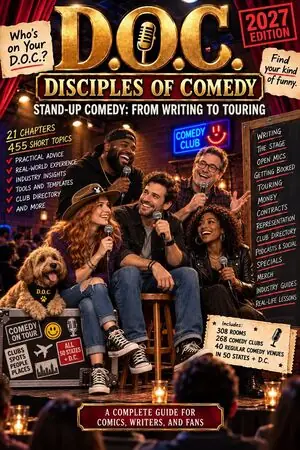
Over 1,000 pages and over 450 short topics, in the order a career runs: writing, the act, the stage, open mics, getting booked, money and the road. The course's modules point you to its chapters.
Try thisRead the chapter that matches the module you're on, then do that module's assignment.
Judy Carter · Indie Books International
Judy Carter's guide to writing and performing stand-up comedy.
Try thisPick one exercise and draft material from your own life, then try it out and revise it.
Book
Stephen Rosenfield · Chicago Review Press
A guide to writing and performance that looks at comedians' work to talk about technique.
Try thisFind one idea about clarity or delivery and use it on one of your bits.
Book
Steve Martin · Scribner
Martin's memoir of his stand-up years: learning the craft, building an act of his own and taking it to arenas.
Try thisNotice his choices about repetition, identity and change, and how your own path compares.
Book
Judd Apatow · Random House
Conversations with comedians and comedy writers about their lives and their work.
Try thisCompare two answers about the creative process, and take one habit to try this week.
Book
Judd Apatow · Random House
A second collection of conversations with comedy performers and writers, newer voices among them.
Try thisNotice where the performers see it differently, then build a routine that fits your life.
Book
D.O.C.
Clips and specials from the comics' own channels, kept to PG-13: pick your lane and press play.
Try thisUse the “Watch for this” line in the module you're on, then pick a clip from the lane it names.
Free, on D.O.C.
Mike Birbiglia · directed by Eddie Schmidt
A documentary that follows Birbiglia as he develops new material.
Try thisFollow how an observation becomes a performance, and keep a version history of one of your bits.
Peacock
Jerry Seinfeld · Netflix
Seinfeld goes back to the club where he started, mixing stand-up with stories of his early years.
Try thisWatch how much background he gives before a joke, then practice setting up a story of your own.
Netflix
Netflix
A series of half-hour stand-up sets, a different comedian in each episode.
Try thisCompare two comics' openings, transitions and closers. Note the technique, not the lines.
Netflix
Showtime
A documentary series about the people and the history of the Los Angeles club.
Try thisTake one habit from the stories that you can use in your own scene.
Paramount+
HBO
A two-part documentary about Carlin's life and work.
Try thisNotice how his material changed across a long career, and what makes a voice personal.
HBO Max
Pete Holmes · HBO
A scripted series about a comic finding his way in the New York comedy scene.
Try thisUse an episode to talk about preparation, then check the rules of the mics near you.
HBO Max
Prime Video
A scripted series about a woman taking up stand-up in late-1950s New York.
Try thisWatch for stage presence and storytelling; the dialogue and the timing are written.
Prime Video
Robert De Niro · Sony Pictures Classics
A drama about a veteran stand-up comic, played by Robert De Niro, directed by Taylor Hackford.
Try thisEnjoy it as fiction, and talk through what the character's choices say about an audience.
Film
D.O.C.
Shows hosted by comedians, A to Z: the hosts, the newest episode and where to listen, with a player on the page.
Try thisPick a show hosted by a comic whose style you like, and note one thing they say about how they work.
Free, on D.O.C.
Mike Birbiglia
Birbiglia and a guest work through new, untested material and talk about the process.
Try thisListen for an idea getting clearer, then try that kind of revision on a premise of your own.
Podcast · free episodes
Stuart Goldsmith
Long conversations with comedians about how they write, perform and keep going.
Try thisPick a guest whose style differs from yours and try one of their habits for a week.
Podcast · free episodes
D.O.C.
Your first five, an idea taken to a tight five, twenty joke shapes and AI as a practice partner.
Try thisOpen the tab that fits the joke in front of you and use one of its templates tonight.
Free, on D.O.C.
D.O.C.
One question to a page, answered from the D.O.C. book: open mics, writing, the stage, getting booked and the road.
Try thisFind the question you're stuck on this week and do the one thing its answer suggests.
Free, on D.O.C.
Judy Carter
Carter's introductory guide to writing your first stand-up material.
Try thisChoose one approach and write an original draft; judge it by clarity and by trying it live.
Free article
MasterClass
A public article on punchlines and joke structure.
Try thisWrite several endings for one setup of your own, keeping your material apart from the article's examples.
Free article
MasterClass
A video course on gathering material, finding a comedic voice and building an act.
Try thisDo one lesson's writing or rehearsal task before you watch the next.
Membership
Stephen Rosenfield · New York
A New York school offering stand-up classes, workshops and coaching.
Try thisAsk about feedback, stage time, the schedule, access and the full cost.
Paid classes
Nothing on the shelf matches that yet. Clear the search or a filter to see more.
Links checked 10 October 2026. Prices, streaming services and class dates change, and a public library is a great place to start. D.O.C. is independent of the publishers, schools and streaming services named here.
A four-week plan to fit around the mics near you, your budget and your life. Take it at your own pace; getting good is a long, happy road.
Tick a step once you've done it.
0 of 6 steps done
Start with one observation. Give it an ending. Say it out loud. Now you've got something to work on.
Open the notebook →Yes. There’s no sign-up and nothing to buy. Your notes, progress and practice stay in your browser on this device, and you can download them any time.
Often three to five minutes, and the host tells you the exact time when you sign up. Build for the slot you’re given, with room for laughs.
Stage Time lists tonight’s open mics near you that comedy clubs publish, and Houston, Dallas–Fort Worth and Austin room by room. Bars, coffee shops and clubs host them; ask the host how sign-up works before you go.
Your set list, a pen, your phone to record (ask first), and a way to pay for a drink or a small fee if the room has one. Arrive before sign-up opens.
A few cue words on a small card are plenty, and you’ll see them at open mics. Learn your opener and your closer cold, so you can look up at the room.
Carry on with your next line; the audience comes with you. A quiet moment is information for the rewrite, and module 6 shows you how to use it.
Record your sets when the room allows it, and watch them yourself first. Post the clips you’d happily show a friend; a practice recording can stay private and still do its job.
A class adds structure, feedback and stage time. Compare the teacher, the class size, the live practice, the full cost and the schedule. You can also start today: write, rehearse and go to a mic.
No. Write for the audience you want and the comedy you want to make. Clean means different things in different rooms, so ask a booker which subjects and words to leave out.
It varies from comic to comic. Paid spots go to material you can count on, a clip that shows it and the slot length a booker needs. Module 9 covers what to have ready.
No. Your own life is your material, at any age. Check a room’s age rules before you sign up: some rooms are 21 and over.
The Stand-Up Starter Workbook puts the course on paper: the ten assignments as worksheets, a set-list sheet, a mic log, the four-week plan and a booking checklist, ready to take to the mic. It's free when you become a Disciple. Become a Disciple, free →
By D.O.C. Editorial. The Stand-Up Starter Course, D.O.C.'s free guide to how to start stand-up comedy, is built on D.O.C.'s companion book, Stand-Up Comedy: From Writing to Touring, and its chapters on writing, the act, the stage, open mics and getting booked. The practice examples are written for this course, and the shelf links to each title's own page. Updated 10 October 2026.
Updated 10 October 2026 · Comic's Corner · Privacy