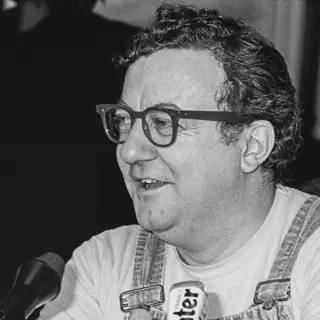
Coluche
Also known as Michel Colucci
Who Coluche is
Coluche was one of France's best-known comedians, a César-winning actor and the founder of the Restos du Cœur. Born Michel Colucci in 1944, the son of Italian immigrants, he was a comedian, actor and humanitarian whose humour took aim at the authorities. He won the César for Best Actor for Tchao Pantin in 1984.
On 26 September 1985 he appealed on Europe 1 radio for volunteers for a free canteen for people in need, the Restos du Cœur; more than 5,000 volunteers answered and served 8.5 million meals that first winter, and the charity he founded carried on after his death on 19 June 1986. Coluche was a stand-up comedian from Montrouge, France, the working-class suburb on the edge of Paris where he grew up.
He came up in the Paris stage troupes of the late 1960s and early 1970s, as one of the founders of the Café de la Gare in 1969, and in 1974 went out alone in a one-man show, in the overalls that became his stage costume. On screen he played alongside Louis de Funès in L'Aile ou la Cuisse (1976), and on 30 October 1980 he declared himself a candidate for the French presidency.
He was married to Véronique Kantor from 1975 to 1981, and they had two sons, Romain and Marius; he was killed in a motorcycle accident at Opio, near Grasse. His sketches, among them C'est l'histoire d'un mec and Le Schmilblick, came out on records from 1974, and in 1985 he set a world motorcycle speed record on the Nardò ring in Italy.
Vote for Coluche
Put Coluche in My D.O.C. Legends: your twelve for their era, counted with every reader’s on the Legends page.
At a glance
- Born
- 1944
- Died
- 1986
- From
- Montrouge, France
- Albums
- Enregistrement public. Vol. 1, Coluche, Edition spéciale and 3 more
- Podcasts and radio
- Y'en aura pour tout le monde
- On screen
- Le Pistonné, Les vécés étaient fermés de l'intérieur, L'Aile ou la Cuisse and 10 more
Specials, shows and podcasts
Albums
- Enregistrement public. Vol. 1 Pathé, 1974
- Coluche RCA, 1978
- Edition spéciale Martinez Lederman, 1985
- Edition spéciale 2 Paul Lederman Productions, 1986
- Enfoirés, excusez nous. Les Blagues de Coluche sur Europe 1 Martinez Lederman, 1986
- Mimi 86 Martinez Lederman, 1986
On screen
- Le Pistonné film
- Les vécés étaient fermés de l'intérieur film, 1976
- L'Aile ou la Cuisse film, 1976
- Vous n'aurez pas l'Alsace et la Lorraine film, director, 1977
- Inspecteur la Bavure film, 1980
- Le Maître d'école film, 1981
- Deux heures moins le quart avant Jésus-Christ film, 1982
- Banzaï film, 1983
- La Femme de mon pote film, 1983
- Tchao Pantin film, 1983
- La Vengeance du serpent à plumes film, 1984
- Dagobert film, 1984
- Le Fou de guerre film, 1985
Podcasts and radio
- Y'en aura pour tout le monde radio, host
Their stand-up
Coluche was born on 28 October 1944, the son of a florist and of a house painter, an Italian immigrant who died three years later.
Coluche grew up in Montrouge, a working-class suburb on the edge of Paris, after being born in the city's 14th district. As a teenager he went through one short job after another, as a florist, a vegetable seller, in a ceramicist's workshop and washing dishes in restaurants, while he pictured himself as a street singer.
His full name was Michel Gérard Joseph Colucci, and he was raised in Montrouge by his mother, Simone, who brought up her two children alone after his father died in 1947. School held little interest for him, and he only just passed his school-leaving certificate, in 1958.
Motorcycles were a passion from his teens, when he delivered his mother's flowers on a small Suzuki 50. His friend René Metge, later his brother-in-law and a winner of the Paris-Dakar, rode it on the Montlhéry circuit, where Coluche came to know motorcycle racing and admired the riding of Georges Monneret.
He tried his hand as a musician in the cafés of Paris, which brought him to Georges Moustaki, who became his friend, helped him with money, gave him a place to live and gave him his first real motorcycle. At 26 he took the stage name Coluche.
In 1969 he was one of nine friends, among them the playwright Romain Bouteille, Sotha, Miou-Miou, Patrick Dewaere and Henri Guybet, who built a 180-seat theatre with their own hands: the Café de la Gare, which opened in Montparnasse in June 1969. The same year he made his first film, Le Pistonné, for the director Berri, who later cast him in Le Maître d'école and Tchao Pantin.
At the Café de la Gare his driving ambition grated on the others, who one day put it to him: him or them. They stayed, and he went.
In 1971 he started a troupe of his own, Le Vrai Chic Parisien. He wrote and staged its show Ginette Lacaze 1960 – chronique des mœurs chantée, created in 1972, which played the Olympia in Paris as the first half of Dick Rivers's Rock'n'Roll Show, and in September 1973 Introduction à l'esthétique, at Au Vrai Chic Parisien in Paris.
In Le Vrai Chic Parisien he fell in love with Véronique Kantor. Their son Romain was born in 1972, they married in 1975, and a second son, Marius, was born in 1976.
In 1974 he staged Martin Lamotte's Le Crépuscule des lâches, then left the troupe to work alone in a one-man show, in overalls, yellow boots and a red nose. His characters were the barroom philosopher, the violent boor and the happy fool, and his sketches took aim at advertising, officials, journalists and politicians.
Swiss television's A bâtons rompus showed him on 20 April 1974, still little known, in pink trousers and a wool waistcoat with his name stitched on it, doing his first sketch, C'est l'histoire d'un mec, and Et vous trouvez ça drôle. On 5 May 1974, the night of the first round of the French presidential election, he did C'est l'histoire d'un mec on France's first channel, and his career took off.
Pathé put his sketches on record from 1974: C'est l'histoire d'un mec, with Sur le pont de l'Alma, on a single, and Enregistrement public. Vol. 1, an album recorded before an audience.
In February 1975 FR3's evening news covered his show at the Olympia in Paris, with rehearsals and sketches, among them his take-off of Léon Zitrone. On 26 October 1976 he brought Ginette Lacaze 1960 back at the Élysée-Montmartre, playing Bobby, with Josiane Balasko, Thierry Lhermitte, Gérard Lanvin, Christian Clavier and Martin Lamotte in the cast.
His sketch Le Schmilblick, recorded before an audience with Martin Lamotte and Christine Dejoux and put out on a Pathé Marconi single in 1975, went out on every radio station that year and made him a star across France.
On New Year's Eve 1976 he was the special guest of Swiss television's holiday evening, in the blue-striped overalls and yellow T-shirt that became his stage costume. On 8 February 1977 he played a one-man show with his own band at Le Déjazet in Paris.
His screen career grew with two films of 1976, Patrice Leconte's Les vécés étaient fermés de l'intérieur and L'Aile ou la Cuisse, directed by Zidi, in which he played alongside Louis de Funès. In 1977 he directed a film himself, Vous n'aurez pas l'Alsace et la Lorraine.
In 1978 RCA gathered the sketches he had recorded live from 1974 to 1977, among them Le Flic, L'Auto-stoppeur, Le C.R.S. arabe and Le Schmilblick, on a set of three records titled Coluche.
On the radio his cheek on Europe 1 came to irritate the Élysée, and RMC let him go after ten days. By 1980, at the height of his fame, he was shut out of the media.
On 2 October 1980 he opened Mes adieux au music-hall, a show he conceived and performed alone, at the Théâtre du Gymnase in Paris, and on 30 October 1980 he declared himself a candidate for the 1981 presidential election. Polls gave him up to 16 percent, and the sociologist Pierre Bourdieu and the philosopher Gilles Deleuze came out for him, before he withdrew early in 1981.
He ran, he said, to expose the chronic inefficiency of France's politicians, and his slogan said that until then France had been cut in two, while with him it would be folded in four, the French way of saying doubled up with laughter. On Swiss television on 28 November 1980 he spoke of his disenchantment with the political class and his surprise at the support he had found.
As the polls rose, France's police intelligence service opened a file on him, and he received death threats signed by Honneur de la police, a clandestine far-right group. Boycotted by the media and opposed from every side, he called on voters as he withdrew to back the Socialist candidate, François Mitterrand.
A painful time followed, marked by his divorce from Véronique, in 1981, and by the suicide of his friend Patrick Dewaere with the rifle Coluche had given him. Coluche sank into depression and drugs, hashish and then heroin, hid his absent gaze behind dark glasses on television, and on 18 June 1983 faked his own suicide on L'Heure de la vérité, soon after the young comic Jean-Yves Lafesse had said he no longer made them laugh. After the divorce he fell in love with Frédérique Fayles-Bernstein, who stayed with him until his death.
In the early 1980s he made Inspecteur la Bavure (1980) and Banzaï (1983) with Zidi again, Le Maître d'école (1981) with Berri, Yanne's Deux heures moins le quart avant Jésus-Christ (1982) and Blier's La Femme de mon pote (1983). In Berri's Tchao Pantin (1983) he turned to drama as Lambert, a petrol-station attendant who grows fond of a young dealer; Dino Risi's Dagobert (1984) and Le Fou de guerre (1985) followed.
When he was given the César in 1984 for Tchao Pantin, he could not hold back his tears: he said he was very moved, thanked Berri, and joked that he had thought himself safe from a César, since his films were the kind that win no awards but still sell tickets.
He lent his name to SOS Racisme in 1984 and to the 1985 campaign against hunger in Ethiopia. In 1985 he and the comedian Thierry Le Luron staged a mock wedding, Coluche in a white bridal gown and a blond wig, riding in a horse-drawn carriage to a reception on the Champs-Élysées before nearly 1,000 onlookers, to send up the much-covered wedding of the newsreader Yves Mourousi.
Through his friend Érick Courly, a journalist at Moto 1, he wrote for the motorcycle press, and in 1980 Motoplay had him test the Harley-Davidson 1340. Over the years he owned many motorcycles, among them a Yamaha 500 RDLC painted pink, a Honda CB1000 and a Kawasaki 900 Z. In 1985 he entered a Yamaha FZ 750 of the Moto 2000 team, with three professional riders, in the 24 Heures Motos at Le Mans.
A first try at the world speed record for a 750cc motorcycle, then 219 km/h, ended in a mechanical failure on the Nardò ring in Italy on 17 July 1985. He went back in September 1985 with the backing of Elf and, on the Yamaha 750 OW31 that Patrick Pons had ridden to second place at the 1979 Bol d'Or, set the world record for the flying kilometre on a track, at 252.087 km/h.
His appeal of 26 September 1985 went out live on his Europe 1 radio show, Y'en aura pour tout le monde. The first Restos du Cœur opened on 21 December 1985 in a tent on a vacant lot in Paris's 19th district, Jean-Jacques Goldman wrote the charity's song after Coluche came to ask him for one, and Coluche pressed in Strasbourg for Europe's food surpluses to be opened to it.
On 2 November 1985 Swiss television's Trèfle d'or put him through a send-up of L'Heure de vérité, in which three Swiss journalists questioned him as the minister of nothing. On 26 January 1986 he brought artists and public figures together for a large charity broadcast on TF1 for the Restos du Cœur.
His later records came out on Martinez Lederman and Paul Lederman Productions: Edition spéciale, recorded before an audience, in 1985, then in 1986 a second Edition spéciale, Mimi 86 and Enfoirés, excusez nous, the jokes he made on Europe 1. RCA France had put out Mes adieux au music hall as a set of three records in 1984.
On 19 June 1986, at about half past four in the afternoon, he was riding his motorcycle back from lunch in Cannes, with two friends, his helmet hanging from the handlebars, when a semi-trailer coming the other way cut across his path near Opio, close to Grasse, to turn into a dump. He hit the front of the truck head-on and was killed outright, at 41.
On hearing of his death, President François Mitterrand said it was heart-wrenching, that he had known him well, and that he was a lover of life who had just lost it.
At the end of his life he had stopped paying his taxes, so his sons inherited debts and at first refused his estate, taking it back some years later once the tax office had been repaid from his rights, Marius said in June 2026. Véronique Colucci took over the Restos du Cœur at his death and was its president from 1998 to 2003; she died in 2018.
In 1987 Europe answered his call and opened its food surpluses to charities that give out food aid, and on 20 October 1988 France enacted the Loi Coluche, voted unanimously by Parliament, which gives a tax reduction to people who donate to charities. In 2026 more than 80,000 regular volunteers of the Restos du Cœur gave out 186 million meals.
Career timeline
- 1944Born
- 1974Enregistrement public. Vol. 1 (Pathé, 1974) Album
- 1976Les vécés étaient fermés de l'intérieur (film, 1976) On screen
- 1976L'Aile ou la Cuisse (film, 1976) On screen
- 1977Vous n'aurez pas l'Alsace et la Lorraine (film, director, 1977) On screen
- 1978Coluche (RCA, 1978) Album
- 1980Inspecteur la Bavure (film, 1980) On screen
- 1981Le Maître d'école (film, 1981) On screen
- 1982Deux heures moins le quart avant Jésus-Christ (film, 1982) On screen
- 1983Banzaï (film, 1983) On screen
- 1983La Femme de mon pote (film, 1983) On screen
- 1983Tchao Pantin (film, 1983) On screen
- 1984La Vengeance du serpent à plumes (film, 1984) On screen
- 1984Dagobert (film, 1984) On screen
- 1985Le Fou de guerre (film, 1985) On screen
- 1985Edition spéciale (Martinez Lederman, 1985) Album
- 1986Edition spéciale 2 (Paul Lederman Productions, 1986) Album
- 1986Enfoirés, excusez nous. Les Blagues de Coluche sur Europe 1 (Martinez Lederman, 1986) Album
- 1986Mimi 86 (Martinez Lederman, 1986) Album
- 1986Died
Questions and answers
What podcast does Coluche host?
Y'en aura pour tout le monde.
What TV shows and films is he in?
Le Pistonné (film), Les vécés étaient fermés de l'intérieur (film, 1976), L'Aile ou la Cuisse (film, 1976), Vous n'aurez pas l'Alsace et la Lorraine (film, director, 1977), Inspecteur la Bavure (film, 1980) and Le Maître d'école (film, 1981), among 13 credits.
Where is Coluche from?
Montrouge, France.
How old was Coluche?
Coluche was born in 1944 and died in 1986.
The D.O.C. letter, free
Who’s on the road, festival dates as they are announced and entry windows as they open, with the news of the comedians, rooms and towns you follow: one short comedy newsletter, free every Sunday.
The full SUCDb record
The full record — the career in order, the specials and credits — is on SUCDb, with a button to vote them into My D.O.C. Legends.
Updated · the record checked 17 October 2026