























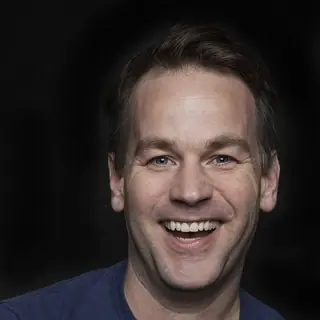

One spine for the night
A long set can be a run of separate bits or one story with jokes along the way. A useful reading of Birbiglia’s solo shows is that the story supplies momentum while the jokes supply moments. The two jobs overlap but are not the same: a joke can work without moving the story, and a story beat can matter without a laugh. This is a lens for studying the shows, not a rule for how long-form comedy must work.
From one-liners to stories
Birbiglia’s official biography lists six solo shows and says they merge storytelling and comedy. In a 2012 email interview with the North Coast Journal, he says he started out writing one-liners after seeing Steven Wright perform. He traces the change to 2003, when he told a personal story at a show presented by The Moth; he says it became the title story of My Girlfriend’s Boyfriend. He says his shows now hold as many jokes as his earlier stand-up, but the jokes add up to something more emotional.
A story is not an anecdote
“I missed my train” is an anecdote. A story asks what the person wanted and what the missed train cost them: say, a toast they were meant to give at a friend’s wedding, now delivered by phone from the platform. The want gives the jokes something to push against, and the cost gives the story somewhere to go. That example is a teaching illustration, not a quotation from a Birbiglia show.
His own life as the source
In a 2013 interview with Paste, Birbiglia says he has yet to write a stand-up show that is not autobiographical. He recalls advice from his first manager, Lucien Hold: material about your own life cannot be stolen. He says his early material was more observational. He also says the show My Girlfriend’s Boyfriend took shape from a piece he performed at a This American Life live event, after which he and his director, Seth Barrish, decided it should become its own show.
Choosing what to reveal
Personal material asks the performer to decide which details to share and in what order. That decision is a craft choice. A detail earns its place when it sharpens what the person wants or raises what they stand to lose. This describes a stage construction; it is not a reading of Birbiglia’s private life.
Years of rewriting
Birbiglia tells Paste that he workshopped My Girlfriend’s Boyfriend for more than four years in front of hundreds of audiences, and kept rewriting it for another year after its Off-Broadway run before filming it. He describes making significant writing changes based on audience reactions in London and Australia, and says he wants his shows to capture a human experience rather than work only through cultural references. He says a show at 80 percent still has a solid 20 percent to refine, and that specificity is usually what he is trying to add. These are his own accounts of his process.
Specific is not obscure
A detail can be specific without being obscure. A personal detail can be pictured by anyone once it is described; a reference works only for listeners who already know it. One useful reading is that long-form material leans on the first kind, because the story has to reach people who arrive knowing nothing about the performer. This is a lens for revision, not a rule.
Jokes, chunks, one narrative
A 2023 post in Matt Ruby’s newsletter Funny How quotes Birbiglia describing to Neal Brennan, on the Neal’s Blocks podcast, how he writes a funny solo show. In that account he starts with a large pile of jokes, most of which do not work, keeps roughly a hundred that do, and asks whether they could become about ten stories or chunks. He then asks whether those chunks can become a single narrative. In the 2013 Paste interview, he described Thank God for Jokes, then in development, as 90 minutes of stand-up tied together by a theme, and said he did not yet know whether it would become a dense narrative or a tight set. The newsletter quotes a podcast remark; it is not a full transcript.
What makes a chunk part of a story
A chunk becomes part of a narrative when it changes something the next chunk depends on: a want, a risk, or a piece of information. Without that link, chunks stay separate pieces joined by segues. A simple check is to remove one chunk and ask whether the next still makes sense; if nothing breaks, the link may be weak. This is a teaching test, not a description of how a Birbiglia show is assembled.
A show that keeps changing
In a 2019 interview with the Twin Cities Arts Reader, Birbiglia says The New One, which he had been touring since 2017, was still changing as the tour reached its final two cities. He says he performs a show for college, comedy club, and theater audiences, and that each show teaches him more about what he has written. He describes enjoying taking jokes apart with fellow comedians. The official description of his podcast, Mike Birbiglia’s Working It Out, says he works out original, untested material with a different comedian or creator each week.
What this study establishes
This study draws on three interviews, a newsletter’s quotation of a podcast remark, his official biography, and an official podcast description. The interviews are self-reported accounts given years apart, and this study does not check them against scripts or recordings. It does not report audience counts or a coded analysis of the specials. Searches for this study did not identify academic work devoted to Birbiglia; that is not proof that none exists. A larger study could compare a story as first told at a live storytelling or radio event with its version in a filmed special, marking each added, cut, or moved passage with consistent labels.