






















The odd detail comes first
Everyday subjects are common property. Anyone can name a frustration with travel, errands, or small social rituals. One useful reading of Seinfeld’s approach is that the work lies in two later steps: finding the odd detail inside the subject, and finding the exact words that let a room see it. This is a lens for studying the act, not a rule governing his routines.
A session with an end
In a 2020 podcast interview with Tim Ferriss, Seinfeld calls stand-up “the profession of writing” and says he grasped that principle young. He recommends treating writing as a session with a fixed end time rather than an open-ended struggle; for his daughter, he suggested an hour. When the time is up, he says, the writer stops and takes a reward. He also says the people who become great are the ones who put in a great many hours. These are his own accounts of his practice.
A topic is not yet a line
“Hotel key cards” names a topic. An angle names the odd expectation inside it: a card that works at the front desk and fails at the room door, while the guest somehow feels at fault. A first draft of that angle might take a paragraph to explain; a working version might need two sentences. That example is a teaching illustration, not a quotation from a Seinfeld routine.
From notebook to legal pad
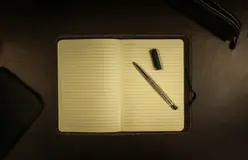
Seinfeld tells Ferriss that he usually works from 15 or 20 pages of material in various states of development, alongside a smaller notebook of random observations. He compares an observation to a distant target and describes trying to write something a nightclub audience could hear and then see the way he sees it. If he is lucky, a first attempt fills half a page or a page on a yellow legal pad. In the next day’s session he looks at what he likes and does not like, and he says, as any writer could, that the work is 95 percent rewriting.
Economy is a test, not a rule
One way to read this process is as a search for the fewest words that still carry the picture. Each word can be asked what it does: place the listener, sharpen the expectation, or hold the rhythm. Cutting can make a line clearer, but shorter is not automatically better; a setup sometimes needs room before the turn. This is a lens for revision, not a measurement of Seinfeld’s scripts.
Play first, then polish
Seinfeld describes two phases: free creative play, then polish and construction. In the second, he says, he spends large amounts of time refining each word until it flows in a way that pleases his ear. He describes being nurturing toward new writing on the day it is written, then strict the next day, deciding what has to come out, be redone, or be thrown away. In the same interview he compares stand-up to math and music.
Hear it before the room does
If the ear is the editor, reading a line aloud is a practical test. A sentence that looks clean on the page may stumble when spoken, and an extra clause can delay the picture. A writer can mark where a breath falls and where the word that completes the picture lands. These are rehearsal possibilities, not descriptions of how Seinfeld times particular lines.
Desk, stage, desk
Seinfeld describes taking polished material to the stage as an experiment. In his account, the audience response tells him which parts are very good, which are only okay, and which are terrible, and the material then goes back through rewriting. He sums up the cycle as desk, stage, and back to the desk, without end. Asked what other feedback he uses, he says there is none. This is a self-reported method from one interview.
A bit has versions
If material returns to the desk after each performance, a bit exists as a series of versions rather than one fixed text. Dated drafts make those changes visible: what was cut, what was added, where the order shifted. Comparing two versions can show whether a revision clarified the picture or only shortened it. This is a study method, not a claim about how long any particular Seinfeld bit took to develop.
Keeping the pages
An Associated Press report from 27 November 2020 describes thousands of yellow pages that Seinfeld kept for years in accordion folders, and reports that he calls them the most valuable thing he has. Netflix’s description of the special Jerry Before Seinfeld says it includes a library of legal pads holding every joke he has written since 1975. The AP report says his book Is This Anything? gathers that material in chronological order. The Publishers Weekly review notes that the book’s monologue-style jokes sit on the page in stacked lines, almost like a script.
What this study establishes
The documented sections rest on one long podcast interview, a wire report, a book review, and an official program description. Seinfeld’s account of his process is self-reported, and this study does not check it against his drafts. It does not report audience data, word counts, or a coded analysis of his specials. Searches for this study did not identify an accessible academic analysis devoted to his stand-up writing; that is not proof that none exists. A larger study could pair the jokes as printed in the book, which is arranged in chronological order, with recorded performances of the same material, mark each change in wording, and code the changes consistently while keeping alternative explanations.