



























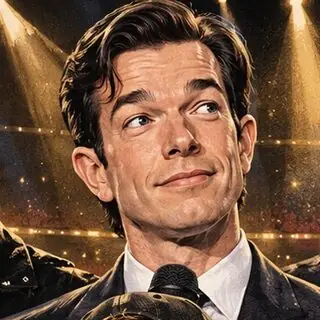

A story built to be followed
A long story asks the audience to hold a lot in mind: who is involved, where they are, and what has already happened. When the listener can follow it, each new detail has somewhere to land. A useful reading of Mulaney’s stand-up is that a clearly laid-out story gives its later turns room to work. This is a lens for watching the act, rather than a rule it follows.
Built in front of people
In a 2015 interview with Weekly Alibi, Mulaney says stand-up lets him try jokes out constantly, and that he told one story over and over onstage before telling it on television. He contrasts the forms: in stand-up he describes things so people can imagine what they want, while television has to account for what is seen. In a 2015 Pipe Dream interview, he says he likes to open a set with something from the moment, such as the city, the venue, or how he walked out, rather than going straight into prepared material, though he says it depends.
Describe so they can picture it
A summary tells the audience what happened. A description lets them see it. Consider an original teaching example: saying a motel pool was bad gives a verdict, while one plastic chair beside a pool with a long list of posted rules gives a picture the audience can judge for themselves. That example is a teaching illustration, not a quotation from a Mulaney routine.
When the sentence is right
In a 2018 profile in The Ringer, Mulaney describes a “muscle memory” for when he gets a sentence the way he likes it; the writer links this to landing on the right turn of phrase or the exact timing of a pause. He also recalls describing himself as the one who likes precision, while his longtime collaborator Nick Kroll improvises, and adds that he has since come to enjoy working without a script more. The Television Academy lists him as the 2018 winner of Outstanding Writing for a Variety Special for John Mulaney: Kid Gorgeous at Radio City.
The specific word
A precise word can carry attitude as well as meaning. Two words may name the same thing but suggest a different speaker, era, or level of formality. Saying a sentence aloud shows where a plainer word would lose something. These are possibilities to examine in a recording or a draft, not measurements of specific Mulaney performances.
Long stories, few seams
Paste’s 2018 review of Kid Gorgeous at Radio City describes Mulaney’s words as carefully chosen and his material as long, detailed stories rather than conventional setups and punchlines, with the comedy growing as details accumulate. The reviewer notes set pieces joined without awkward segues and a couple of well-timed callbacks. This is a critic’s reading of one special, not Mulaney’s own account of his method.
What a callback does
A callback returns to something the audience heard earlier. It can connect separate stories, reward attention, or show that an earlier detail meant more than it seemed. Consider an original teaching example: a coworker who signs each email with a full job title reappears, in a later story, signing a birthday card the same way. The return needs no explanation if the first mention was clear. That example is a teaching illustration, not a quotation from a Mulaney routine.
An analogy pushed past its limit
The same profile describes a bit from The Comeback Kid as an analogy that begins as a cliché and becomes new by pushing the hypothetical to its breaking point and then several lines beyond. Mulaney tells the writer that the Kid Gorgeous material was written in advance, and that taping it carried an urgency once the writing stopped. The description of escalation is the writer’s reading, not a formula from Mulaney.
Light character touches
In a 2019 Fresh Air interview, Mulaney says that for his Saturday Night Live audition he chose stand-up jokes with slight character touches rather than full immersion in characters, and that his voice did not change much. He also recalls writing host monologues with Simon Rich for about three years, work he describes as helping hosts with the moment of standing onstage to deliver a funny speech. In the 2015 Weekly Alibi interview, he says that at Saturday Night Live, writing for changing guest hosts, a joke that did not work for the person saying it had to change.
The people inside the story
Characters in a story do not always need a full change of voice. A small shift in rhythm or word choice can mark who is speaking while the narrator stays in charge. A useful reading is that light character touches keep the storyteller’s viewpoint at the center. This describes a stage construction; it does not describe Mulaney’s private personality.
What the research establishes
This study uses published interviews, a published profile, a critic’s review, and the Television Academy’s award record. The interviews are self-reported, and the profile and review include their writers’ readings. The sources do not establish a formula for callbacks or prove why any audience laughs. Searches for this study did not identify academic work on his story structure or callbacks; that is not proof that none exists. A larger study would choose recordings, timecode each story’s setup, turns, and returns, apply consistent labels, and ask a second observer to check them.